Introduction
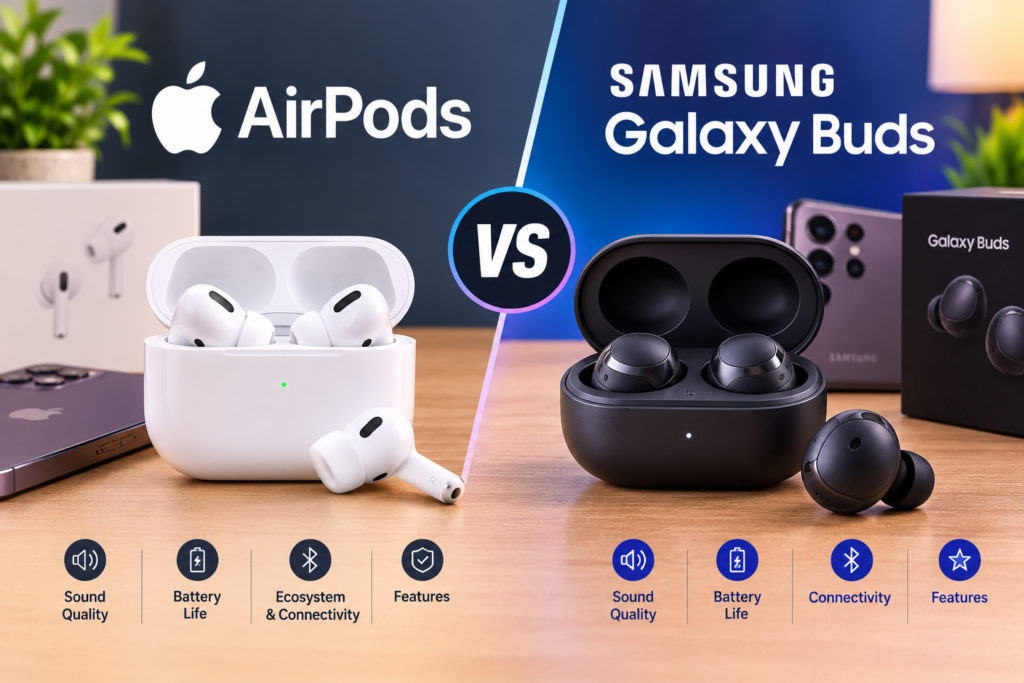
Wireless earbuds have become essential accessories for listening to music, taking calls, watching videos, and attending online meetings. Among the most popular options are Apple AirPods and Samsung Galaxy Buds. Both product families offer convenient wireless connectivity, compact designs, and features intended to improve everyday listening experiences.
However, choosing between them can be challenging. Apple AirPods are particularly attractive to iPhone users because of their seamless integration with Apple’s ecosystem. Samsung Galaxy Buds, meanwhile, are designed to work especially well with Samsung Galaxy smartphones and offer features that appeal to Android users.
Both brands offer multiple models with different prices, sound profiles, battery capacities, and noise-cancellation capabilities. The best choice depends on your smartphone, budget, preferred listening experience, and the features you value most.
In this guide, we compare Apple AirPods and Samsung Galaxy Buds across design, sound quality, active noise cancellation, battery life, connectivity, call quality, comfort, and price to help you choose the right wireless earbuds.
1. Apple AirPods vs Samsung Galaxy Buds: Overview
Apple AirPods and Samsung Galaxy Buds serve similar purposes, but their software integration and product features differ.
Apple offers several AirPods models, including standard AirPods, AirPods Pro, and AirPods Max headphones. Samsung’s Galaxy Buds lineup includes standard and premium wireless earbuds with features that vary by generation.
The following table provides a general comparison of the two product families.
| Feature | Apple AirPods | Samsung Galaxy Buds |
|---|---|---|
| Best suited for | iPhone and Apple ecosystem users | Samsung Galaxy and compatible Android users |
| Design options | Open-fit earbuds and silicone-tip models | Primarily in-ear designs, depending on model |
| Active noise cancellation | Available on selected models | Available on selected models |
| Sound quality | Balanced sound with model-dependent features | Customizable sound with model-dependent features |
| Wireless connectivity | Bluetooth and Apple ecosystem integration | Bluetooth and Samsung ecosystem integration |
| Battery life | Depends on model and listening settings | Depends on model and listening settings |
| Water resistance | Available on selected models | Available on selected models |
| Companion app | Apple settings and supported features | Galaxy Wearable app and supported features |
| Premium features | Spatial Audio, selected adaptive listening features | Selected 360 Audio and adaptive sound features |
| Price range | Varies by model and generation | Varies by model and generation |
Specifications and features differ significantly between individual products. Compare equivalent models before making a purchase.
2. Design and Comfort
Comfort is an important consideration because wireless earbuds are often worn for several hours at a time.
Apple AirPods Design
Apple AirPods are known for their minimalist appearance and lightweight construction. Standard AirPods typically feature an open-fit design, while AirPods Pro models use silicone ear tips to create a more secure seal.
The open-fit design may appeal to people who dislike having silicone tips inside their ears. It can also make it easier to remain aware of surrounding sounds, although it generally provides less passive noise isolation.
AirPods Pro models offer a more enclosed fit, which can help improve bass response, isolation, and active noise cancellation.
Apple’s compact charging cases are designed to make carrying and charging the earbuds convenient.
Samsung Galaxy Buds Design
Samsung Galaxy Buds models generally use an in-ear design, although their shape, size, and fit vary by generation.
Silicone ear tips on compatible models help create a seal inside the ear canal. A good seal can improve bass performance and passive noise isolation.
Samsung’s earbuds also feature compact charging cases, with designs that differ between generations.
Comfort depends on ear shape and personal preference. Some users prefer Apple’s open-fit AirPods, while others find the secure fit of Galaxy Buds more suitable for exercise or commuting.
Winner: Neither brand is universally more comfortable. Apple may suit people who prefer open-fit earbuds, while Samsung’s in-ear options may appeal to users who want a more secure seal.
3. Sound Quality
Sound quality is one of the most important factors when choosing wireless earbuds.
Apple AirPods Sound Quality
Apple AirPods generally deliver a clear, balanced listening experience, although the sound signature varies by model.
Compatible models offer detailed vocals, controlled bass, and a sound presentation suitable for different music genres.
AirPods Pro models combine their in-ear design with noise cancellation and software-based audio processing to create an immersive listening experience.
Selected models also support Personalized Spatial Audio, which can make compatible music and video content feel more immersive.
For users who listen to music through an iPhone, Apple’s hardware and software integration can make the overall experience particularly convenient.
Samsung Galaxy Buds Sound Quality
Samsung Galaxy Buds also offer clear audio, with sound characteristics depending on the model and listening settings.
Compatible models provide customizable equalizer settings through Samsung’s software, allowing users to adjust the sound according to their preferences.
Some models emphasize bass, while others aim for a more balanced sound profile. Premium Galaxy Buds models may include advanced audio processing and spatial audio features.
Samsung’s integration with compatible Galaxy devices can also unlock selected audio features that may not be available on other smartphones.
Which Sounds Better?
There is no universal winner because sound preferences are subjective and individual models differ.
Apple AirPods are a strong option for users who want a straightforward listening experience within Apple’s ecosystem.
Samsung Galaxy Buds are appealing to users who prefer customizable audio settings and integration with compatible Galaxy smartphones.
For the best comparison, listen to similarly priced models using the same music and comparable settings.
4. Active Noise Cancellation
Active noise cancellation, commonly called ANC, uses microphones and electronic processing to reduce unwanted background sounds.
This feature can be particularly useful on airplanes, public transportation, busy streets, and in shared workspaces.
AirPods Noise Cancellation
Apple offers active noise cancellation on selected AirPods models, particularly AirPods Pro.
These models are designed to reduce distracting environmental noise while allowing users to focus on music, podcasts, calls, or other audio.
Compatible models also offer Transparency mode, which allows outside sounds to pass through so users can remain aware of their surroundings.
Selected newer models include adaptive listening features that automatically adjust audio behavior according to environmental conditions and user settings.
Standard AirPods without ANC do not provide the same level of active noise reduction.
Galaxy Buds Noise Cancellation
Samsung offers active noise cancellation on selected Galaxy Buds models.
Compatible earbuds use microphones and audio processing to reduce certain background sounds. Many models also offer ambient sound modes that let users hear their surroundings.
The effectiveness of noise cancellation depends on the model, ear-tip fit, background noise, and software settings.
A secure seal is especially important because outside noise can enter through gaps between the earbuds and the ear canal.
Which Has Better Noise Cancellation?
Premium AirPods Pro and premium Galaxy Buds models can both provide useful noise-cancellation performance.
The winner depends on the exact products being compared, as well as fit and listening conditions.
If noise cancellation is a priority, compare premium models rather than assuming every AirPods or Galaxy Buds product includes this feature.
5. Battery Life and Charging
Battery life affects how conveniently earbuds can be used throughout the day.
Apple AirPods Battery Performance
Battery performance varies across the AirPods lineup.
Apple publishes separate estimates for listening time with and without active noise cancellation, where applicable. Charging cases provide additional listening time before they need to be recharged.
Selected models support wireless charging, while charging connections and case capabilities depend on the generation.
Battery performance can decline over time as rechargeable batteries age.
Samsung Galaxy Buds Battery Performance
Samsung Galaxy Buds also provide different battery estimates depending on the model, listening volume, and features being used.
Active noise cancellation generally consumes additional power. Streaming calls, enabling advanced audio features, and using higher volumes can also reduce listening time.
Compatible charging cases provide additional battery capacity, and selected models support wireless charging.
Which Offers Better Battery Life?
Neither brand consistently wins across every model.
When comparing earbuds, check both the listening time available from a single charge and the total listening time provided by the charging case.
Also consider whether the advertised battery estimates assume active noise cancellation is switched off.
6. Connectivity and Device Compatibility
Connectivity is one of the biggest differences between Apple AirPods and Samsung Galaxy Buds.
Apple AirPods Compatibility
AirPods work particularly well with Apple devices, including iPhones, iPads, and Macs.
Features such as automatic switching between compatible Apple devices, simplified pairing, and Find My integration can make the experience especially convenient.
AirPods can also connect to compatible non-Apple devices through Bluetooth, but some ecosystem-specific features may be unavailable.
This makes AirPods a particularly attractive option for people who already use several Apple products.
Samsung Galaxy Buds Compatibility
Samsung Galaxy Buds connect to compatible devices through Bluetooth, but selected features work best with Samsung Galaxy smartphones and tablets.
The Galaxy Wearable app provides access to supported settings, including sound customization, noise control, and other features depending on the model.
Some advanced audio options may require a compatible Galaxy device, supported software, or particular system versions.
Galaxy Buds can also work with other Bluetooth-compatible devices, although the available features may differ.
Which Offers Better Connectivity?
Apple AirPods are generally the more convenient choice for users who regularly switch between iPhones, iPads, and Macs.
Samsung Galaxy Buds are especially appealing to Samsung Galaxy owners who want access to the brand’s integrated software features.
For users who frequently switch between Android and Apple devices, check the compatibility of specific features before buying.
7. Call Quality and Microphone Performance
Wireless earbuds are useful for phone calls, video conferences, voice messages, and online meetings.
Apple AirPods include microphones and voice-processing features designed to help users communicate clearly. Compatible models also offer features intended to reduce background noise during calls.
Samsung Galaxy Buds similarly use multiple microphones and audio processing to improve voice pickup.
However, microphone performance varies by model and can be affected by wind, traffic, crowds, and other environmental sounds.
For professional calls, neither brand should be judged solely by its reputation. A premium model from either lineup may perform better than an older or less expensive alternative.
If you frequently attend online meetings, look for independent microphone tests conducted in quiet rooms and noisy environments.
8. Features and Software Integration
Additional features can make one pair of earbuds more valuable than another.
Apple AirPods Features
Depending on the model, AirPods can offer:
- Automatic switching between compatible Apple devices.
- Spatial Audio with supported content.
- Personalized Spatial Audio on compatible devices.
- Transparency mode and active noise cancellation on supported models.
- Find My integration.
- Audio sharing with compatible Apple devices.
- Siri access and selected adaptive audio features.
These features are particularly useful for people who already use Apple’s ecosystem.
Samsung Galaxy Buds Features
Depending on the model and connected device, Galaxy Buds can offer:
- Sound customization through supported software.
- Active noise cancellation and ambient sound modes.
- Integration with compatible Galaxy devices.
- Selected 360 Audio features.
- Device-finding capabilities.
- Touch controls and customizable settings.
- Additional software features on supported Samsung smartphones.
Feature availability varies by generation and device compatibility.
Which Has Better Features?
Apple AirPods offer an integrated experience for users of Apple products.
Samsung Galaxy Buds provide an attractive set of features for Samsung Galaxy users, particularly those who want sound customization and compatible device integration.
The better choice depends on the smartphone and other devices you already own.
9. Price and Value for Money
Price is an important factor when deciding between AirPods and Galaxy Buds.
Both brands offer products at different price points, from relatively affordable models to premium earbuds with advanced noise cancellation and audio features.
Entry-level models can be suitable for everyday listening, while premium models typically offer more sophisticated noise control, additional listening features, or improved hardware.
Samsung Galaxy Buds may offer attractive value in certain price categories, especially when retailer discounts are available.
Apple AirPods can also become more affordable during seasonal promotions and retailer sales.
Prices vary by country, generation, and retailer, so compare current prices rather than relying on launch prices.
When evaluating value, consider the following:
- Sound quality and comfort.
- Active noise cancellation, if required.
- Battery life and charging features.
- Smartphone compatibility.
- Warranty and after-sales support.
- The availability of discounts.
- Whether premium features justify the extra cost.
Best value tip: Buy the model that offers the features you actually need rather than automatically choosing the most expensive earbuds.
10. Apple AirPods vs Samsung Galaxy Buds: Pros and Cons
Apple AirPods Pros
- Seamless integration with compatible Apple devices.
- Convenient pairing and device switching.
- Clear sound quality across the product range.
- Premium models offer effective noise-control features.
- Compact designs and convenient charging cases.
Apple AirPods Cons
- Some features work best within Apple’s ecosystem.
- Premium models can be expensive.
- Standard models may lack active noise cancellation.
- Open-fit designs may not suit everyone.
Samsung Galaxy Buds Pros
- Strong integration with compatible Samsung Galaxy devices.
- Sound customization on supported models.
- Multiple options with different features and prices.
- Premium models offer noise cancellation.
- Secure in-ear designs on many models.
Samsung Galaxy Buds Cons
- Some features are limited to compatible Samsung devices.
- Fit and comfort vary between models.
- Noise cancellation and battery performance differ by generation.
- Advanced features may not work identically across all Android devices.
11. Which Should You Buy?
The right choice depends largely on your smartphone and listening preferences.
Choose Apple AirPods if:
- You use an iPhone, iPad, or Mac.
- You want convenient switching between Apple devices.
- You regularly use Siri or other Apple ecosystem features.
- You prefer Apple’s audio integration.
- You want AirPods-specific features such as Personalized Spatial Audio on compatible models.
Choose Samsung Galaxy Buds if:
- You use a Samsung Galaxy smartphone.
- You want customizable sound settings on supported models.
- You prefer the fit of Samsung’s in-ear designs.
- You want access to Galaxy-specific audio features.
- You find a Galaxy Buds model that offers better value within your budget.
Consider either brand if:
You use another Bluetooth-compatible smartphone and primarily care about music, podcasts, and calls. In this case, compare individual models based on sound quality, comfort, battery life, and compatibility.
Conclusion
Apple AirPods and Samsung Galaxy Buds are both compelling choices for people looking for wireless earbuds. However, they offer different advantages depending on the user’s devices and priorities.
Apple AirPods are generally the better choice for iPhone users who want seamless connectivity, convenient device switching, and integration with Apple’s services.
Samsung Galaxy Buds are particularly attractive to Samsung Galaxy users who value sound customization, in-ear designs, and compatibility with Samsung’s software features.
For sound quality, noise cancellation, microphone performance, and battery life, the result depends on the exact models being compared rather than the brand alone.
Overall, choose Apple AirPods if you use Apple devices, and choose Samsung Galaxy Buds if you use a Samsung Galaxy smartphone. If you are using another Android phone, compare individual models and prices to determine which earbuds provide the best combination of sound, comfort, and features for your needs.