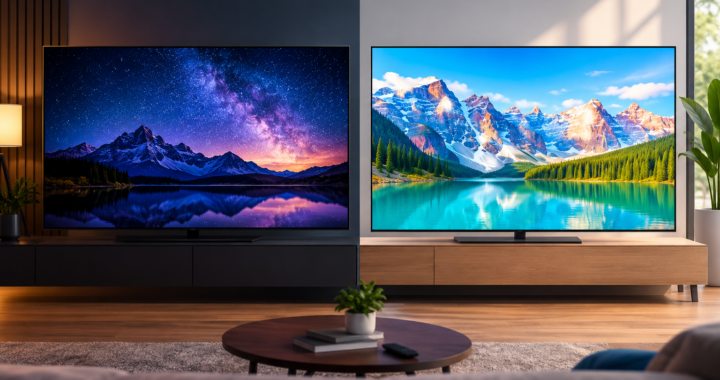
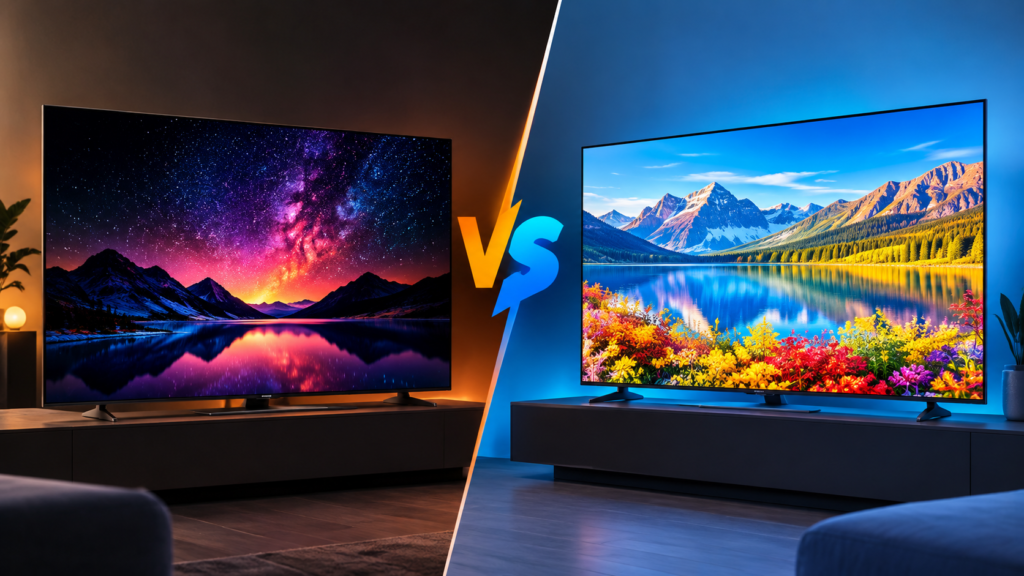
Choosing a new television can be challenging, especially when comparing OLED and QLED display technologies. Both offer impressive picture quality, vibrant colors, and advanced features, but they work differently and provide distinct viewing experiences. Whether you enjoy watching movies, playing video games, streaming sports, or watching everyday television, understanding these differences can help you make the right decision.
OLED TVs are widely recognized for their deep blacks, excellent contrast, and exceptional picture quality. QLED TVs, on the other hand, are known for their high brightness, vivid colors, and suitability for brightly lit rooms. Both technologies have improved significantly, making the choice less straightforward than it once was.
In this guide, we compare OLED and QLED TVs based on picture quality, brightness, contrast, color accuracy, gaming performance, durability, pricing, and overall value.
What Is an OLED TV?
OLED stands for Organic Light-Emitting Diode. Unlike traditional LCD televisions, OLED TVs do not require a separate backlight to illuminate their screens.
Instead, each pixel produces its own light. This allows individual pixels to turn completely off when displaying black, creating exceptionally deep blacks and excellent contrast.
For example, when watching a nighttime scene in a movie, an OLED TV can display a dark sky while maintaining the brightness of stars, streetlights, and other illuminated objects. This pixel-level control creates a realistic and immersive viewing experience.
Key Features of OLED TVs
- Self-illuminating pixels without a separate backlight.
- True black levels and outstanding contrast.
- Excellent viewing angles.
- Accurate colors and detailed images.
- Fast pixel response times for gaming.
- Slim designs and modern aesthetics.
OLED televisions are particularly popular among movie enthusiasts, gamers, and viewers who prioritize cinematic picture quality.
However, OLED technology also has some limitations. OLED screens may not reach the same brightness levels as the brightest QLED models, and static images displayed for extended periods can contribute to permanent image retention or burn-in.
What Is a QLED TV?
QLED stands for Quantum Dot Light-Emitting Diode. Despite the similar name, most QLED televisions are LCD TVs that use quantum dots to improve color performance and rely on an LED-based backlight.
Quantum dots are tiny semiconductor particles that help produce vivid, bright, and accurate colors when illuminated by the backlight.
Because QLED TVs use a separate backlight, their brightness can be increased significantly. This makes them attractive for rooms with large windows, strong daylight, or bright overhead lighting.
Some advanced QLED televisions also feature Mini-LED backlighting. Mini-LED technology uses many smaller LEDs to provide more precise control over different areas of the screen, improving contrast and reducing unwanted light around bright objects.
Key Features of QLED TVs
- High brightness levels.
- Vivid colors and strong color volume.
- Good performance in bright rooms.
- No typical OLED-style burn-in risk under normal use.
- Wide selection of screen sizes and prices.
- Availability of advanced Mini-LED models.
QLED TVs are suitable for families, sports fans, and viewers who want a bright, colorful screen for everyday entertainment.
However, because standard QLED televisions use a backlight, they generally cannot produce the same pixel-level black control as OLED displays. Their contrast performance depends heavily on the quality of their backlighting and local dimming systems.
OLED vs QLED: Key Differences at a Glance
| Feature | OLED TV | QLED TV |
|---|---|---|
| Display technology | Self-emissive pixels | Quantum dots with an LCD backlight |
| Black levels | Excellent, with true blacks | Varies by model |
| Contrast | Outstanding | Good to excellent, depending on local dimming |
| Brightness | Generally lower than the brightest QLED models | Often higher |
| Color quality | Rich, accurate colors | Vivid colors and strong color volume |
| Viewing angles | Generally excellent | Vary by panel type |
| Gaming | Excellent response times | Excellent on suitable gaming models |
| Burn-in risk | Possible under certain usage patterns | No typical OLED-style burn-in risk |
| Bright-room performance | Good, depending on model | Often excellent |
| Dark-room performance | Excellent | Depends on backlight control |
| Price | Often more expensive than budget LCD TVs | Available across a wide range of budgets |
| Best suited for | Movies, gaming, and dark-room viewing | Bright rooms, sports, and everyday entertainment |
Actual performance varies by model, screen size, panel type, and generation.
1. Picture Quality: Which Looks Better?
Picture quality is one of the most important factors when purchasing a television.
OLED TVs generally have an advantage because each pixel controls its own light. This creates precise highlights, deep blacks, and excellent contrast. Dark scenes look particularly impressive because black pixels can switch off completely.
For movie lovers, this can make a significant difference when watching content with dramatic lighting, nighttime scenes, or shadowy environments.
QLED TVs can also deliver excellent picture quality, especially premium models with advanced processing and Mini-LED backlighting. Their quantum dot technology produces vibrant colors, while sophisticated local dimming systems improve contrast.
However, some QLED models may show blooming, which occurs when bright objects appear against dark backgrounds and light spreads into nearby darker areas.
Winner: OLED for overall contrast and dark-scene detail. Premium QLED and Mini-LED TVs can still deliver excellent results, particularly in brighter environments.
2. Brightness: Which Is Better for Bright Rooms?
Brightness is an important consideration if your living room receives plenty of sunlight.
QLED TVs generally have an advantage in this area. Their LED backlights can produce high brightness levels, helping images remain visible in rooms with strong ambient light.
This makes QLED televisions particularly useful for watching daytime sports, news, and television programs in bright living spaces.
OLED TVs have improved considerably in brightness, especially newer premium models. Nevertheless, many QLED and Mini-LED televisions can still achieve higher sustained or full-screen brightness.
If your television sits opposite a large window or you regularly watch during the day, a bright QLED model may be the more practical choice.
Winner: QLED for bright-room viewing, particularly when comparing OLED with high-brightness QLED or Mini-LED models.
3. Black Levels and Contrast
Contrast describes the difference between the darkest blacks and the brightest whites a television can display.
OLED technology excels here because individual pixels can turn off completely. This creates true black levels and excellent contrast, even when bright objects appear next to dark areas.
For example, watching a space documentary on an OLED TV can reveal a nearly black background with bright stars standing out clearly.
QLED televisions depend on their backlights. Standard models may struggle to keep dark areas completely black when bright objects appear nearby.
However, premium QLED televisions with effective full-array local dimming or Mini-LED backlighting can substantially improve contrast.
Winner: OLED. Its self-emissive pixel technology provides an inherent advantage in black levels and contrast.
4. Color Accuracy and Color Performance
Both OLED and QLED televisions can produce beautiful colors, but their strengths differ.
OLED TVs are known for their rich colors, excellent contrast, and accurate reproduction of dark scenes. They can deliver a natural, cinematic appearance when properly calibrated.
QLED televisions use quantum dots to produce vibrant colors, particularly at high brightness levels. This can make colorful sports broadcasts, animated movies, and HDR content look especially striking.
Premium QLED models can maintain strong color volume at high brightness, while OLED televisions can provide excellent color reproduction and precise highlights.
The overall result depends on the individual television’s panel, picture settings, and color processing rather than the display label alone.
Winner: Both perform well. QLED often has an advantage in bright, highly saturated images, while OLED excels at combining color with deep blacks and contrast.
5. Gaming Performance: OLED vs QLED
Gamers should consider refresh rates, input lag, response times, HDMI connectivity, and support for variable refresh rates.
OLED televisions offer exceptionally fast pixel response times. This helps reduce motion blur during fast-paced games and makes quick movements appear sharp.
Many modern OLED models also support high refresh rates, HDMI 2.1 features, variable refresh rate technology, and automatic low-latency modes.
QLED televisions can also provide excellent gaming performance. Many models offer 120Hz or higher refresh rates, low input lag, and gaming-focused features. Premium models may be particularly attractive to players who want a large, bright display.
OLED’s potential burn-in risk is worth considering if you play the same game for many hours with persistent static interface elements. Modern OLED televisions include protective features, but these reduce rather than completely eliminate the risk.
Winner: OLED for response times and motion clarity. QLED remains an excellent choice, especially for bright gaming rooms and buyers seeking value.
6. Viewing Angles: Which Is Better for Families?
Viewing angles matter when several people watch television from different positions.
OLED TVs generally maintain their color quality and contrast when viewed from the side. This makes them suitable for larger living rooms where family members sit across a wide sofa or around the room.
QLED viewing angles vary depending on the LCD panel technology and any special optical layers used. Some models lose contrast or show changes in color when viewed from off-center positions.
Premium QLED televisions may improve this behavior, but performance differs between models.
Winner: OLED in most comparisons. It generally provides a more consistent viewing experience from different seating positions.
7. Lifespan and Burn-In Risk
Durability is another factor to consider before choosing a television.
OLED displays use organic materials that gradually wear with use. If the same bright, static image remains on the screen for extended periods, uneven pixel wear can eventually cause permanent image retention, commonly called burn-in.
This does not mean every OLED television will develop burn-in. Normal mixed-content viewing is generally less concerning, and modern televisions use protective technologies to reduce the risk.
QLED televisions do not have the same typical OLED-style burn-in concern because they use LCD panels and LED backlights. They may still experience other problems over time, including backlight degradation or panel defects.
For households that display static dashboards, news tickers, or game interfaces for many hours each day, QLED may offer greater peace of mind.
Winner: QLED for resistance to typical OLED burn-in.
8. Price and Overall Value
OLED televisions are often positioned in the premium market, although prices vary considerably depending on the brand, screen size, and model generation.
They are attractive for buyers who prioritize cinematic picture quality and are willing to spend more for deep blacks, excellent contrast, and fast response times.
QLED televisions cover a broader price range. Budget-friendly models are widely available, while premium Mini-LED televisions can cost as much as or more than some OLED models.
When comparing prices, consider the entire package rather than focusing only on display technology. Features such as refresh rate, local dimming, HDR performance, processing quality, connectivity, and warranty can make a substantial difference.
Winner: QLED for budget flexibility. OLED can offer excellent value for buyers who prioritize picture quality and find a suitable model at a competitive price.
9. Which Is Better for Watching Movies and Sports?
The best choice depends on what you watch and where you watch it.
For movies: OLED is often the preferred option because of its deep blacks, high contrast, and excellent shadow detail. It is particularly impressive in darker rooms.
For sports: QLED can be an excellent choice because of its high brightness and vivid colors. These qualities help sports broadcasts look lively in bright living rooms.
For streaming: Both technologies work well with popular streaming services. HDR support, picture processing, and the quality of the source content can matter as much as the display technology.
For family television: QLED may be more practical in bright, shared spaces, while OLED can provide a more cinematic experience for evening viewing.
10. Which Should You Buy: OLED or QLED?
Your ideal television depends on your viewing habits, room conditions, and budget.
Choose an OLED TV if:
- You watch many movies and premium television shows.
- You prefer deep blacks and excellent contrast.
- You frequently watch television in a dark or moderately lit room.
- You play fast-paced games and value quick pixel response times.
- You often watch from different seating positions.
- You want a cinematic viewing experience.
Choose a QLED TV if:
- Your living room receives substantial daylight.
- You want a bright screen for daytime viewing.
- You regularly watch sports or colorful entertainment.
- You prefer a wider selection of budget-friendly models.
- You display static content for extended periods.
- You want to avoid the typical OLED-style burn-in concern.
Before purchasing, compare reviews of the specific models you are considering. A high-quality Mini-LED QLED television may outperform an entry-level OLED in some situations, while a good OLED may deliver a substantially better picture than an inexpensive QLED.
Frequently Asked Questions
1. Is OLED better than QLED?
OLED generally offers better black levels, contrast, and viewing angles, while QLED often delivers higher brightness and greater flexibility across different budgets.
2. Which TV lasts longer, OLED or QLED?
Both can provide years of service. QLED avoids typical OLED-style burn-in, while actual lifespan depends on usage, manufacturing quality, and operating conditions.
3. Is OLED worth the extra money?
OLED may be worth the additional cost for viewers who prioritize cinematic picture quality, deep blacks, excellent contrast, and fast gaming response times.
4. Which is better for gaming, OLED or QLED?
OLED generally offers faster pixel response times, but many QLED televisions also provide excellent gaming features, including high refresh rates and low input lag.
5. Can OLED TVs suffer from burn-in?
Yes. OLED screens can develop permanent image retention after prolonged exposure to static elements, although modern protective features help reduce the risk.
Conclusion
OLED and QLED televisions both offer impressive viewing experiences, but they serve slightly different needs.
OLED is the better choice for viewers who prioritize deep blacks, exceptional contrast, cinematic movies, and responsive gaming. Its self-illuminating pixels create a level of dark-scene precision that conventional backlit televisions cannot fully replicate.
QLED is often the better choice for bright rooms, daytime viewing, vibrant sports broadcasts, and buyers seeking more price options. Premium Mini-LED models can also deliver excellent contrast and impressive HDR performance.
Ultimately, there is no single winner for every household. Consider your room’s lighting, viewing habits, budget, and preferred screen size before making a decision. Comparing individual models will help you find the television that delivers the best balance of picture quality, features, and value for your needs.