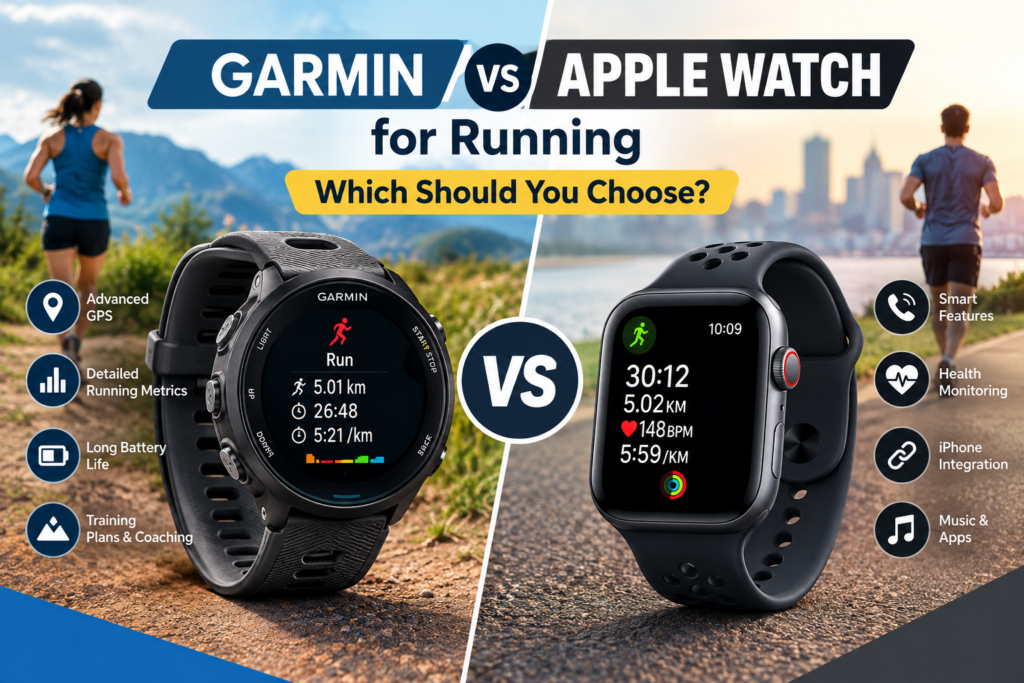
Choosing the right running watch can make a significant difference to your training experience. A good running watch helps you track distance, monitor pace, analyze heart rate, review performance, and understand your progress over time. Two popular options among runners are Garmin watches and the Apple Watch.
Garmin is widely recognized for its running-focused features, detailed training metrics, and long battery life. The Apple Watch combines fitness tracking with smartphone connectivity, health monitoring, and everyday smartwatch convenience.
But which one is better for running? The answer depends on your experience level, training goals, smartphone, budget, and preferred features.
In this article, we compare Garmin and Apple Watch across GPS accuracy, running metrics, battery life, training tools, comfort, and price to help you choose the right device.
1. Garmin vs Apple Watch: An Overview
Garmin offers several watches designed specifically for runners, including models from its Forerunner series. Depending on the model, these watches provide advanced workout tracking, training-load analysis, recovery guidance, and detailed performance statistics.
Garmin devices are particularly appealing to people who follow structured training plans, prepare for races, or regularly run long distances.
The Apple Watch, including the Apple Watch Series and Apple Watch Ultra models, combines running features with a broader collection of health and smart functions. It supports GPS-based workouts, pace and distance tracking, heart-rate monitoring, and integration with Apple’s Fitness and Health applications.
Apple Watch users can also access compatible third-party running applications for additional training tools.
The main difference: Garmin emphasizes running performance and training, while Apple Watch combines running capabilities with everyday smartwatch functionality.
2. GPS Accuracy and Distance Tracking
GPS accuracy is essential for runners who want reliable distance measurements, pace calculations, and route records.
Many Garmin running watches include built-in GPS, with selected models offering multi-band GPS and access to multiple satellite systems. These features can improve positioning in challenging environments, such as urban areas with tall buildings or routes surrounded by trees.
Apple Watch models also provide GPS tracking, with advanced models offering additional positioning capabilities. The Apple Watch Ultra lineup is particularly suited to outdoor activities and demanding workouts.
Both brands can provide reliable GPS performance, but results depend on the specific model, satellite conditions, weather, buildings, and the running environment.
For runners who frequently train outdoors, comparing the GPS capabilities of individual models is more useful than assuming one brand is always more accurate.
Winner: Garmin is a strong choice for runners who prioritize dedicated training and GPS features. Apple Watch is also capable of delivering excellent running data, particularly on newer models.
3. Running Metrics and Performance Analysis
Running metrics help athletes understand their pace, endurance, and training progress.
Garmin offers an extensive range of running statistics on compatible watches. Depending on the model, these may include cadence, stride length, ground contact time, vertical oscillation, running power, and predicted race times.
Some Garmin watches also provide training status, training load, and recovery-related recommendations. These features can help runners evaluate whether their training is productive and whether they may benefit from additional recovery.
Apple Watch tracks essential running metrics, including distance, pace, heart rate, splits, and workout duration. Newer software and compatible applications may provide additional statistics and training insights.
Apple’s workout interface is generally straightforward, making it easy for beginners to review their performance without navigating numerous advanced menus.
Runners who want deeper analysis may also use third-party applications with either platform, although the available features vary.
Winner: Garmin for the breadth of built-in running metrics and performance analysis.
4. Training Plans and Coaching Features
Structured training is useful when preparing for a 5K, 10K, half-marathon, or marathon.
Garmin provides training features on many compatible devices, including suggested workouts, training plans, and guidance based on recent activity and recovery information. Certain models can help runners understand their training load and estimate readiness for demanding sessions.
These tools can be particularly useful for people who want a more organized approach to improving their performance.
Apple Watch offers workout guidance through its built-in Workout app and supports numerous third-party running and coaching applications. Users can set distance, time, and calorie goals, customize workouts, and follow compatible training programs.
The Apple ecosystem also makes it convenient to combine running data with broader health and fitness information.
However, the availability of advanced coaching features depends on the watch model, software version, subscription requirements, and application used.
Winner: Garmin for runners who prefer built-in training guidance and performance-focused coaching tools.
5. Battery Life
Battery life is one of the most important differences between Garmin and Apple Watch.
Many Garmin running watches can last several days or longer between charges in smartwatch mode. Some models offer extended GPS battery life, making them suitable for marathon training, ultramarathons, and multi-day outdoor activities.
Actual performance depends on the model, GPS settings, display technology, music playback, and sensor usage.
Apple Watch models generally require more frequent charging. Battery life varies by model, with some devices offering longer endurance than others. GPS workouts, cellular connectivity, music streaming, and always-on displays can increase power consumption.
For everyday runners completing short workouts, frequent charging may not be a major problem. However, it can become inconvenient during long-distance events or multi-day trips.
Winner: Garmin, particularly for runners who prioritize long battery life and extended GPS tracking.
6. Heart-Rate Monitoring
Heart-rate monitoring helps runners understand exercise intensity and manage their training.
Both Garmin and Apple Watch use optical sensors to estimate heart rate from the wrist. They can display real-time readings, record workout averages, and provide heart-rate information after a run.
Garmin integrates heart-rate data with its broader training ecosystem on compatible devices. This can help users evaluate training intensity, recovery, and overall workload.
Apple Watch combines heart-rate tracking with Apple’s health applications and compatible fitness software. Its interface makes it easy to review workout results and monitor broader health trends.
Wrist-based readings can become less reliable during certain activities, particularly when the watch moves around or running conditions affect sensor contact.
Runners who require more consistent heart-rate measurements during intense workouts may benefit from a compatible chest strap, provided their watch and application support it.
Winner: Both are strong options. Garmin offers extensive integration with running metrics, while Apple Watch provides convenient access to health and workout information.
7. Comfort and Design
A running watch should feel comfortable during training, everyday activities, and recovery.
Garmin offers a wide range of designs, from lightweight running watches to larger outdoor models. Many Forerunner watches use lightweight materials and physical buttons, which can be convenient when running in rain or wearing gloves.
The variety of models makes it possible to choose a watch based on wrist size, display preference, and training requirements.
Apple Watch models feature a modern touchscreen interface and interchangeable bands. The Apple Watch Ultra is larger and more rugged than standard Apple Watch models, while standard versions may appeal to people who prefer a smaller smartwatch.
Apple Watch touch controls are convenient for everyday use, although physical buttons can be helpful during workouts when quick interactions are necessary.
Winner: Garmin for runners who prefer lightweight, running-oriented designs and physical controls. Apple Watch is attractive to people who want a versatile everyday watch.
8. Smartwatch Features and Smartphone Integration
Not every runner wants a device dedicated primarily to sports.
Apple Watch is especially appealing to iPhone users because it integrates calls, messages, notifications, music controls, calendars, and numerous applications into one device.
Depending on the model and configuration, users can also make payments, interact with Siri, and access selected functions without reaching for their phones.
Garmin watches provide notifications, music controls, and other smart features, with capabilities varying by model. Some devices support music storage, contactless payments through Garmin Pay in supported markets, and additional applications through Garmin’s ecosystem.
However, Garmin’s primary strength remains fitness and outdoor functionality rather than reproducing every smartphone feature.
Compatibility is important: Apple Watch requires a compatible iPhone, while Garmin watches work with compatible iOS and Android phones, although specific features may vary.
Winner: Apple Watch for users who prioritize smartphone integration and everyday convenience.
9. Music and Audio Features
Listening to music can make running more enjoyable, especially during long training sessions.
Apple Watch supports music playback and streaming through compatible services. Users can listen through supported Bluetooth headphones, with offline listening available for compatible services and configurations.
Selected Garmin watches include onboard music storage and support for compatible streaming services. This allows users to listen to downloaded music without carrying a smartphone, depending on the model and service.
Not every Garmin watch includes music features, so buyers should check specifications before purchasing.
Both platforms can support music-based workouts, but streaming availability, offline downloads, and subscription requirements vary.
Winner: Both are good options. Apple Watch suits people already using Apple’s music ecosystem, while Garmin is appealing to runners who want dedicated training features alongside offline music.
10. Health and Recovery Tracking
Running performance depends on more than distance and pace. Sleep, stress, recovery, and overall activity can also influence training.
Garmin offers health and recovery features on compatible devices, including sleep tracking, stress estimates, body battery measurements, and training-related recovery insights.
These tools can help runners identify patterns in their activity and understand when additional rest may be beneficial.
Apple Watch tracks several health metrics and combines them with activity, sleep, and workout information in Apple’s ecosystem. Depending on the model and region, certain devices also provide additional health features.
Neither platform can determine every aspect of recovery with complete certainty. Their measurements should be treated as estimates that complement personal experience rather than replace it.
Winner: Garmin for training-oriented recovery insights; Apple Watch for integrating running with broader everyday health tracking.
11. Price and Value for Money
Both brands offer multiple price points, although the exact cost depends on the model, region, retailer, and current promotions.
Garmin’s range includes entry-level running watches and premium devices designed for experienced athletes and outdoor enthusiasts. A less expensive Garmin model may provide many essential running features without requiring a premium purchase.
Apple Watch models range from standard versions to more expensive Ultra devices. Buyers should consider the purchase price alongside battery life, durability, software features, and the need for additional accessories.
It is also worth considering long-term value. A watch that supports your training goals for several years may be a better investment than a cheaper device that lacks essential features.
Winner: Garmin often offers better value for dedicated runners, while Apple Watch may offer better overall value for iPhone users who want a single device for fitness and daily activities.
Garmin vs Apple Watch: Comparison Table
| Feature | Garmin | Apple Watch |
|---|---|---|
| Primary focus | Running, sports, and outdoor activities | Smartwatch features, health, and fitness |
| GPS tracking | Excellent on many running models | Excellent on many models |
| Advanced running metrics | Extensive on compatible models | Available through built-in features and compatible apps |
| Training guidance | Strong built-in training ecosystem | Built-in workouts and third-party apps |
| Battery life | Generally longer | Generally shorter |
| Heart-rate tracking | Yes | Yes |
| Recovery insights | Extensive on selected models | Health and fitness insights |
| Smart notifications | Available | Extensive iPhone integration |
| Music playback | Available on selected models | Available |
| Smartphone compatibility | Compatible iOS and Android phones | Requires a compatible iPhone |
| Physical buttons | Available on most models | Digital Crown and buttons |
| Best suited for | Dedicated runners and endurance athletes | Runners seeking an all-purpose smartwatch |
Which Is Better for Beginners?
For beginners, both watches can provide the information needed to build a consistent running routine.
Garmin is a good option if you want structured training guidance, reliable workout recording, longer battery life, and room to explore advanced running statistics as your fitness improves.
Apple Watch may be more appealing if you already use an iPhone and want a straightforward way to track runs, monitor activity, receive notifications, and access other everyday features.
Beginners do not necessarily need expensive devices. A watch that records distance, pace, time, and heart rate can provide enough information to get started.
The most important factor is choosing a device that encourages consistent exercise without making training unnecessarily complicated.
Which Is Better for Marathon Training?
Garmin is often the stronger choice for marathon runners because many of its running-focused models offer extensive training metrics, long battery life, and tools for following structured training plans.
These features can be useful when preparing for long runs, monitoring training volume, and reviewing performance over several weeks.
Apple Watch can also support marathon training, particularly when paired with compatible running applications. Its GPS tracking, heart-rate monitoring, customizable workouts, and health integrations are sufficient for many recreational marathon runners.
For ultramarathons or events lasting many hours, battery life deserves particular attention.
Your choice should depend on your training requirements, the watch model, and whether you value advanced built-in running tools or broader smartwatch functionality.
Final Verdict: Garmin vs Apple Watch for Running
Garmin and Apple Watch are both capable running companions, but they appeal to different types of users.
Choose Garmin if:
- You run regularly and want detailed performance analysis.
- You follow structured training plans or prepare for races.
- You value longer battery life.
- You want built-in training and recovery features.
- You prefer a watch designed primarily for sports and outdoor activities.
Choose Apple Watch if:
- You use an iPhone and want seamless integration.
- You want running, health tracking, notifications, and apps in one device.
- You prefer an interactive touchscreen and a versatile everyday design.
- You enjoy using third-party fitness applications.
- You are comfortable charging your watch more frequently.
Overall, Garmin is the better choice for many dedicated runners, while Apple Watch is an excellent option for people who want running features alongside a full smartwatch experience.
Before buying, compare the specific models, GPS capabilities, battery specifications, and software features. The right watch is the one that supports your training goals and fits naturally into your daily routine.