Wireless audio devices have become an essential part of everyday life. Whether you are listening to music, attending online meetings, watching movies, exercising, commuting, or taking phone calls, having the right audio device can make a significant difference. Two of the most popular options are wireless earbuds and over-ear headphones.
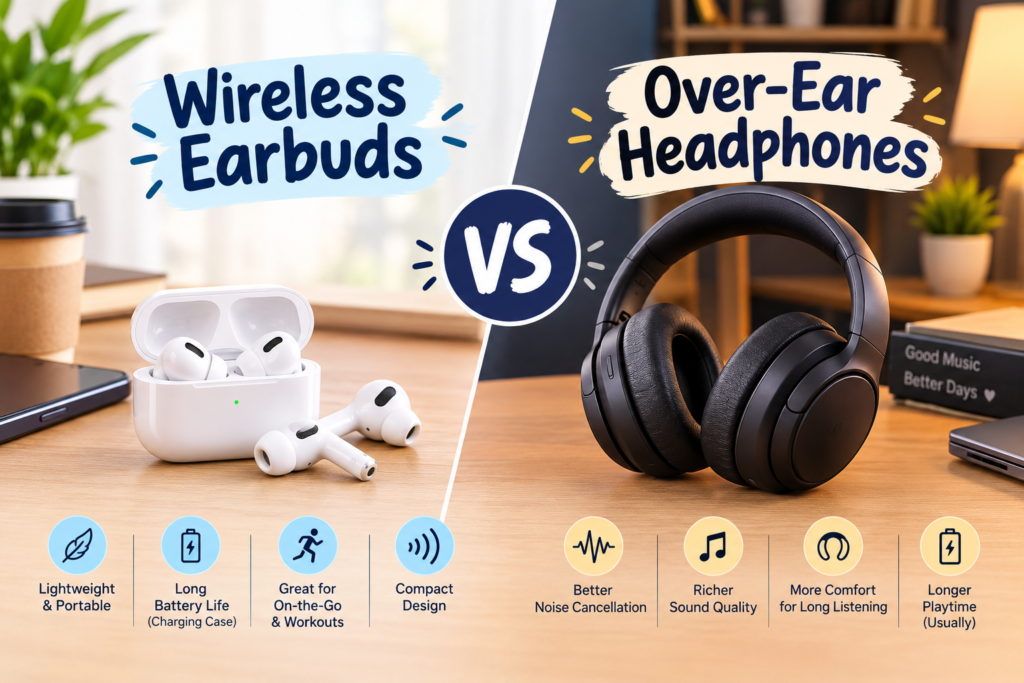
Both offer wireless connectivity, convenient controls, and impressive sound quality. However, they differ in comfort, portability, battery life, noise cancellation, and overall listening experience. Wireless earbuds are compact and easy to carry, while over-ear headphones generally provide larger drivers, longer battery life, and a more immersive listening experience.
Choosing between them depends on your daily routine, personal preferences, budget, and how you plan to use your audio device.
In this guide, we compare wireless earbuds and over-ear headphones across important categories to help you decide which option is better for everyday use.
What Are Wireless Earbuds?
Wireless earbuds are small audio devices designed to fit inside or rest near the opening of your ears. Most modern models connect to smartphones, laptops, tablets, and other compatible devices through Bluetooth.
Many wireless earbuds come with a charging case that protects them when they are not in use and provides additional battery power. Popular features include touch controls, active noise cancellation, transparency modes, voice assistant support, and microphones for phone calls.
Wireless earbuds are particularly popular among commuters, students, fitness enthusiasts, and people who prefer lightweight accessories.
Key advantages of wireless earbuds include:
- Compact and lightweight design.
- Easy portability for travel and commuting.
- Convenient charging cases.
- Suitable for workouts and outdoor activities.
- Quick access to music and calls.
- Available in a wide range of prices.
- Minimal storage requirements.
However, their small size can create limitations. Some users find in-ear designs uncomfortable during extended listening sessions, while others experience difficulties achieving a secure fit.
What Are Over-Ear Headphones?
Over-ear headphones feature large earcups designed to surround the ears rather than sit inside them. They usually include padded ear cushions, an adjustable headband, and larger speaker drivers than typical wireless earbuds.
Many wireless over-ear headphones offer advanced features such as active noise cancellation, multipoint Bluetooth connectivity, customizable equalizer settings, and high-quality microphones.
Their larger design allows manufacturers to incorporate bigger batteries and more substantial acoustic components. As a result, many models deliver a spacious listening experience and extended battery life.
Key advantages of over-ear headphones include:
- Comfortable listening for many users during long sessions.
- Powerful and immersive sound.
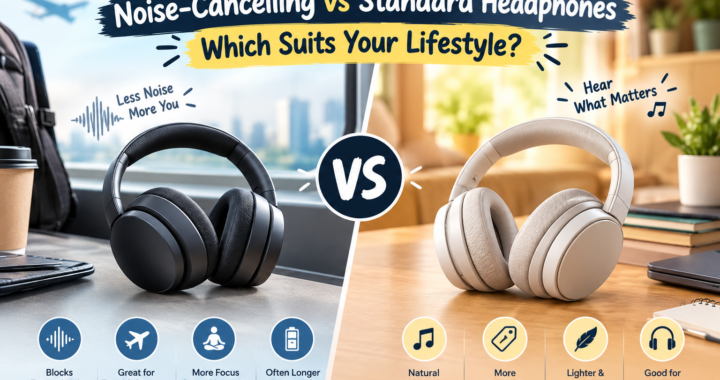
- Strong passive noise isolation.
- Often longer battery life.
- Physical buttons and convenient controls on many models.
- Suitable for work, entertainment, and home listening.
- No need to insert anything into the ear canal.
On the other hand, over-ear headphones are bulkier than earbuds and can become warm around the ears. They also require more storage space and may feel inconvenient during exercise or in crowded environments.
Wireless Earbuds vs Over-Ear Headphones: Quick Comparison
| Feature | Wireless Earbuds | Over-Ear Headphones |
|---|---|---|
| Portability | Excellent | Moderate |
| Weight | Very lightweight | Heavier |
| Sound quality | Very good, depending on the model | Often more spacious and powerful |
| Battery life | Generally shorter per charge | Generally longer |
| Noise cancellation | Available on many models | Often excellent on premium models |
| Comfort | Depends heavily on ear fit | Often suitable for long listening sessions |
| Exercise | Usually better suited | Can be bulky during workouts |
| Travel | Easy to carry | Great for long journeys |
| Phone calls | Good on many models | Often offers more room for microphone systems |
| Storage | Small charging case | Requires a larger bag or storage space |
| Price | Budget to premium | Budget to premium |
| Best use | Commuting, workouts, everyday portability | Work, entertainment, travel, extended listening |
Actual performance varies by model, so these differences should be treated as general tendencies rather than universal rules.
1. Sound Quality: Which Sounds Better?
Sound quality is one of the most important factors when choosing an audio device.
Over-ear headphones often have an advantage because their larger earcups and acoustic design can create a fuller, more spacious sound. Many models reproduce deep bass, detailed vocals, and balanced instrument separation effectively.
They can be particularly enjoyable for listening to music at home, watching films, playing games, or appreciating complex musical arrangements.
Wireless earbuds have improved considerably. Premium models can produce impressive bass, clear vocals, and detailed sound despite their compact size. Some also support high-quality Bluetooth codecs and personalized equalizer settings.
However, the fit of wireless earbuds significantly affects their sound. A poor seal can reduce bass response and weaken noise isolation.
Winner: Over-ear headphones for immersive listening, although high-quality earbuds can compete with many headphones in everyday situations.
2. Comfort: Which Is Better for Long Listening Sessions?
Comfort depends on personal preferences, ear shape, device weight, and how long you wear your audio equipment.
Wireless earbuds are lightweight and convenient, but they sit inside or near the ear canal. Some users experience pressure, irritation, or discomfort after wearing them for several hours. Finding the right ear-tip size can improve comfort and stability.
Over-ear headphones distribute their weight across the headband and surround the ears with padded cushions. Many people find this design more comfortable for extended listening, particularly when working at a desk or studying.
Nevertheless, poorly designed headphones can create pressure around the ears or become uncomfortable for people wearing glasses. Their cushions may also trap heat during warm weather.
Winner: Over-ear headphones for many extended listening sessions, while earbuds are often more comfortable for short periods and active use.
3. Portability: Which Is Easier to Carry?
Wireless earbuds are the clear winner when portability matters most.
Their charging cases can easily fit inside a pocket, handbag, or small backpack. You can carry them almost anywhere without worrying about additional storage space.
This makes them particularly useful for public transportation, shopping, walking, and everyday errands.
Over-ear headphones are considerably larger. Although many models fold inward or include carrying cases, they still take up more room in a bag.
For people who travel frequently or prefer carrying minimal accessories, earbuds offer greater convenience.
Winner: Wireless earbuds.
4. Battery Life: Which Lasts Longer?
Battery performance depends on the device, listening volume, Bluetooth features, and whether active noise cancellation is enabled.
Wireless earbuds commonly provide several hours of listening on a single charge. Their charging cases supply additional power, allowing users to recharge them between listening sessions.
However, the earbuds themselves eventually need to return to their case. Losing the case or forgetting to charge it can also create inconvenience.
Over-ear headphones typically offer longer continuous playback. Many models deliver approximately 20 to 60 hours of listening time, depending on the product and settings.
Some premium headphones can operate for several days of regular use before requiring a recharge.
Winner: Over-ear headphones for continuous playback and longer intervals between charges.
5. Noise Cancellation: Which Blocks More Background Noise?
Active noise cancellation, commonly called ANC, uses microphones and electronic processing to reduce unwanted environmental sounds.
Both wireless earbuds and over-ear headphones can offer ANC. However, their effectiveness varies significantly between products.
Over-ear headphones often combine ANC with passive isolation created by their padded earcups. This combination can work particularly well against steady background noise, such as aircraft engines, ventilation systems, and office equipment.
Wireless earbuds can also perform impressively, especially when they fit securely and create an effective seal inside the ears.
Their compact size makes them convenient for commuters who want to reduce background noise without carrying larger headphones.
Some models also offer transparency modes, allowing environmental sounds to pass through when needed.
Winner: Over-ear headphones often have an advantage for overall isolation, but premium noise-cancelling earbuds can perform exceptionally well.
Remember that noise cancellation does not eliminate every sound. Neither device should be relied upon to block important safety signals completely.
6. Everyday Convenience: Which Is Easier to Use?
Wireless earbuds are designed for quick, convenient use. You can remove them from their charging case, connect them to a compatible device, and begin listening within seconds.
Many models support automatic ear detection, touch controls, voice assistants, and seamless switching within a compatible device ecosystem.
Their small size also makes them useful for short phone calls, quick video meetings, and listening while moving around.
Over-ear headphones are convenient in different situations. Their physical buttons may be easier to operate than small touch controls, and their longer battery life reduces charging frequency.
However, carrying them throughout the day can be less convenient, especially when you frequently move between indoor and outdoor environments.
Winner: Wireless earbuds for everyday portability and quick use.
7. Calls and Online Meetings: Which Performs Better?
Both devices can support phone calls, video conferences, and online meetings.
Wireless earbuds are convenient for quick conversations because they are lightweight and easy to carry. Many models use multiple microphones and voice-processing technology to improve speech clarity.
However, microphone performance can vary in windy environments or noisy public spaces.
Over-ear headphones may provide better microphone positioning or more sophisticated microphone systems, particularly in models designed for office work and gaming.
Their comfortable design can also make them suitable for extended virtual meetings.
Still, wearing over-ear headphones for an entire workday may not suit everyone.
Winner: Over-ear headphones for extended meetings in many cases, although premium earbuds can be excellent for calls.
8. Fitness and Outdoor Activities
Wireless earbuds are generally the better option for exercise.
Their lightweight construction allows users to run, walk, cycle on appropriate routes, or work out without carrying bulky equipment. Many sports-oriented models include secure-fit designs and water- or sweat-resistance ratings.
Before purchasing earbuds for exercise, check the manufacturer’s water-resistance specifications and ensure the fit remains secure during movement.
Over-ear headphones can work well for light exercise or indoor workouts, but they may shift during vigorous movement. Their earcups can also trap heat and moisture.
Neither device should be used in a way that prevents you from noticing nearby traffic or other important environmental sounds.
Winner: Wireless earbuds for workouts, running, and active lifestyles.
9. Durability and Maintenance
Durability depends on construction quality, materials, handling, and exposure to moisture.
Wireless earbuds are small and easy to transport, but their compact size also makes them easier to misplace. Their charging cases and tiny components require careful handling.
Earbuds can accumulate earwax and debris, so regular cleaning is important. Their batteries may also become difficult or uneconomical to replace when performance declines.
Over-ear headphones are larger and can be easier to handle, but their hinges, headbands, cables, and ear cushions can wear out over time.
Replacement cushions can extend the useful life of some models.
For both types, check the warranty, repair options, battery replacement policies, and availability of spare parts before buying.
Winner: Neither universally. Durability depends more on product quality, repairability, and maintenance than on the form factor alone.
10. Price and Value for Money
Wireless earbuds and over-ear headphones are available at different price levels, from affordable entry-level products to premium models.
Budget earbuds are attractive for people who want basic wireless audio without spending much. However, inexpensive models may offer weaker microphones, limited battery life, or less effective noise cancellation.
Premium earbuds can become expensive when they include advanced ANC, spatial audio, multipoint connectivity, and ecosystem-specific features.
Over-ear headphones offer similar price flexibility. Affordable models provide basic listening features, while premium versions may include advanced noise cancellation, superior comfort, and extended battery life.
Instead of choosing solely by price, consider how frequently you will use the device and which features matter most.
For example, someone who listens to music for several hours daily may benefit from investing in comfortable headphones. Someone who primarily listens during short commutes may find earbuds a better value.
Winner: Both offer good value, depending on your needs and budget.
11. Which Is Better for Travel?
Both devices can be excellent travel companions, but they suit different travel styles.
Wireless earbuds are ideal for short journeys, sightseeing, walking through airports, and traveling with minimal luggage. They take up very little space and can be used quickly when needed.
Over-ear headphones are often better for long flights, train journeys, and extended listening sessions. Their padded earcups, larger batteries, and effective noise cancellation can make travel more comfortable.
If you frequently take long flights, headphones may be worth the extra space. For short commutes and lightweight packing, earbuds are usually more practical.
Winner: Over-ear headphones for long journeys; wireless earbuds for lightweight travel.
Wireless Earbuds vs Over-Ear Headphones: Which Should You Buy?
The best choice depends on your daily activities.
Choose wireless earbuds if:
- You commute regularly or travel light.
- You exercise, walk, or run frequently.
- You want an audio device that fits in your pocket.
- You prefer lightweight accessories.
- You mainly listen to music for short or moderate periods.
- You want convenient access to calls while moving around.
Choose over-ear headphones if:
- You listen to music for several hours each day.
- You work from home or attend frequent online meetings.
- You prioritize immersive sound and comfortable listening.
- You frequently travel on airplanes or trains.
- You prefer longer battery life.
- You want an audio device for movies, gaming, and focused work.
If you can afford both, owning a pair of earbuds and a pair of headphones can provide greater flexibility. Use earbuds for commuting and exercise, and headphones for working, studying, and relaxing at home.
Final Verdict
Wireless earbuds and over-ear headphones both offer excellent everyday listening experiences, but their strengths are different.
Wireless earbuds are the better choice for portability, workouts, commuting, and quick access to music or phone calls. Their compact charging cases make them especially convenient for people who spend much of their day outside the home.
Over-ear headphones are generally better for extended listening sessions, immersive entertainment, longer battery life, and focused work. Their larger design can provide a more spacious sound experience and comfortable listening for many users.
Ultimately, wireless earbuds are the best all-around option for portability, while over-ear headphones are often the better choice for comfort during long sessions and immersive listening.
Before purchasing, compare sound quality, fit, battery life, microphone performance, noise cancellation, and warranty coverage. The right device is the one that fits your routine rather than simply offering the longest feature list.