Choosing the right headphones can make a significant difference in how you enjoy music, attend online meetings, watch movies, and manage everyday distractions. With so many options available, one of the most common questions buyers face is whether to choose noise-cancelling headphones or standard headphones.
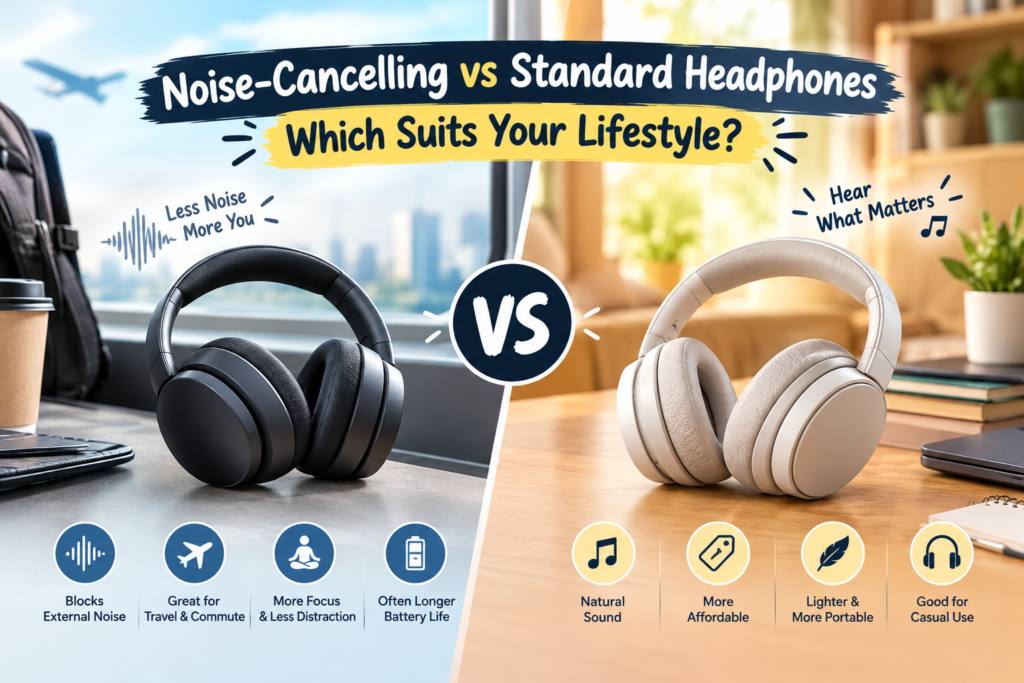
Both types offer useful features, but they serve different purposes. Noise-cancelling headphones are designed to reduce unwanted background sounds, making them especially useful in busy environments. Standard headphones, on the other hand, provide a straightforward listening experience and can be an affordable option for everyday use.
The best choice depends on your lifestyle, listening habits, budget, and the environments in which you typically use headphones.
In this article, we will compare noise-cancelling and standard headphones across sound quality, comfort, battery life, pricing, portability, and everyday practicality to help you decide which option suits your needs.
What Are Noise-Cancelling Headphones?
Noise-cancelling headphones are designed to reduce unwanted environmental sounds so you can concentrate more easily on your audio. They are particularly useful in noisy places such as airplanes, public transport, offices, and crowded cafés.
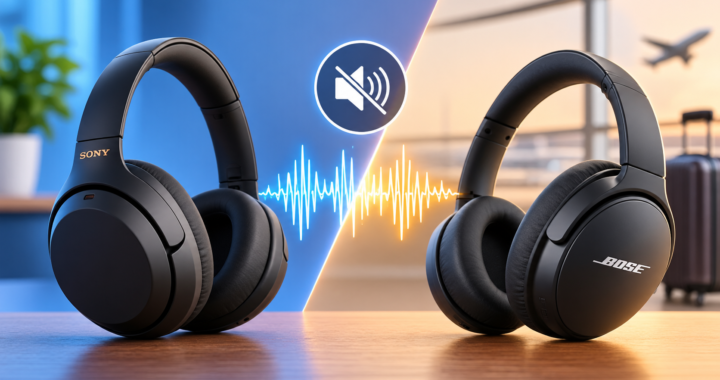
Many modern models use active noise cancellation (ANC), a technology that relies on microphones and electronic processing to reduce external noise.
These microphones detect surrounding sounds, and the headphones generate an opposing sound signal to reduce certain unwanted noises before they reach your ears.
Noise-cancelling headphones can also include passive noise isolation. This happens when the physical design of the ear cups or ear tips blocks some external sound.
Key features of noise-cancelling headphones include:
- Active noise cancellation to reduce certain background sounds.
- Passive noise isolation through ear cups or ear tips.
- Ambient or transparency modes that let outside sounds pass through.
- Wireless connectivity and rechargeable batteries in many models.
- Additional features such as multipoint Bluetooth, customizable sound settings, and app-based controls.
However, not every noise-cancelling headphone performs equally well. Most ANC systems are particularly effective against steady, low-frequency sounds, such as airplane engines and air-conditioning units. Sudden noises and nearby conversations may still be audible.
What Are Standard Headphones?
Standard headphones are conventional audio devices that reproduce sound without active noise cancellation. They are available in several designs, including over-ear, on-ear, and in-ear models.
Some standard headphones offer passive noise isolation through their physical construction, while open-back headphones allow more outside sound to enter.
Because they do not use active noise cancellation, these headphones generally have simpler operating requirements. Wired models do not need batteries to play audio, although wireless standard headphones still require charging.
Common features of standard headphones include:
- Straightforward audio playback.
- Wired or wireless connectivity, depending on the model.
- A wide range of prices and designs.
- Simple controls and easy everyday operation.
- Options suitable for music, gaming, studying, and entertainment.
Standard headphones can be an excellent choice for people who primarily listen to audio in quiet environments and do not need additional noise-control features.
Noise-Cancelling vs Standard Headphones: Key Differences
Understanding the differences between these headphone types can help you identify which one offers better value for your needs.
| Feature | Noise-Cancelling Headphones | Standard Headphones |
|---|---|---|
| Noise reduction | Active cancellation plus possible passive isolation | Primarily passive isolation, depending on design |
| Sound quality | Depends on the model and tuning | Depends on the model and tuning |
| Price | Often more expensive | Available across budget and premium ranges |
| Battery life | ANC and wireless features may consume additional power | Wired models require no battery; wireless models need charging |
| Travel experience | Excellent for reducing steady travel noise | Depends on physical isolation and the surrounding environment |
| Office use | Helpful in noisy workplaces | Suitable for quieter workplaces |
| Comfort | Depends on weight, fit, and ear-cup design | Depends on weight, fit, and ear-cup design |
| Maintenance | May include additional electronics and software | Often simpler, especially for wired models |
| Awareness of surroundings | May require transparency mode | Depends on design and volume |
| Best for | Frequent travellers and people in noisy environments | Everyday listening and budget-conscious buyers |
Neither type is automatically superior in every category. Product design, audio tuning, comfort, and build quality can matter just as much as noise-cancellation technology.
1. Sound Quality: Which Headphones Sound Better?
Sound quality is one of the most important considerations when buying headphones. However, noise cancellation alone does not determine how good a pair of headphones sounds.
Both noise-cancelling and standard headphones can deliver excellent audio. The overall experience depends on factors such as driver quality, frequency response, audio processing, fit, and the music you listen to.
Noise-cancelling headphones can provide a more enjoyable listening experience in noisy environments because reducing background noise makes it easier to hear details in music, podcasts, and videos.
For example, listening to a podcast on a busy train may be more comfortable with ANC headphones because the steady rumble of the train is reduced.
Standard headphones can offer equally impressive sound in quiet surroundings. Some wired models also provide excellent audio performance without relying on wireless connectivity or electronic noise processing.
Winner: It depends on the model and listening environment. Noise-cancelling headphones have an advantage in noisy places, while standard headphones can deliver outstanding sound in quieter settings.
2. Noise Reduction: The Biggest Difference
Noise reduction is the main feature that separates these two categories.
Active noise cancellation is particularly useful when you regularly encounter consistent background sounds. Airplane engines, train noise, ventilation systems, and road noise inside vehicles are examples of sounds that ANC can help reduce.
This can make music and spoken audio easier to hear without constantly increasing the volume.
Standard headphones rely mainly on their physical design to block sound. Over-ear models with well-sealed ear cups may provide reasonable isolation, while some in-ear headphones can reduce external noise through properly fitted ear tips.
However, they generally cannot electronically cancel environmental noise in the same way as ANC models.
It is important to understand that noise cancellation does not make your surroundings completely silent. Loud conversations, sudden announcements, alarms, and other unpredictable sounds may remain audible.
Winner: Noise-cancelling headphones are the better choice if reducing background noise is a major priority.
3. Price and Overall Value
Budget is another important factor when choosing between noise-cancelling and standard headphones.
Standard headphones are available at many price points, including affordable wired earphones, basic wireless headphones, and premium audiophile models. Buyers can often find suitable options without paying for advanced electronic features.
Noise-cancelling headphones typically cost more when comparing products with similar build quality and features. Their microphones, processing systems, batteries, and additional software contribute to the overall cost.
However, prices vary considerably. Some affordable ANC headphones provide useful noise reduction, while premium standard headphones may cost more than entry-level noise-cancelling models.
When evaluating value, consider how frequently you will use noise cancellation.
If you travel regularly or work in a noisy office, the additional expense may be worthwhile. If you mainly listen to music at home, a good standard pair may provide everything you need.
Winner: Standard headphones generally offer better value for buyers who do not need ANC, while noise-cancelling models may justify their higher cost for frequent users.
4. Comfort for Everyday Use
Comfort is essential if you wear headphones for several hours a day.
Noise-cancelling headphones are commonly available as over-ear models with padded ear cups. These can be comfortable for extended listening, although some models feel heavy or create warmth around the ears.
Certain ANC headphones may also produce a slight sensation of pressure for some users. The experience varies between individuals and products.
Standard headphones offer a similarly broad range of designs. Lightweight on-ear headphones, compact earbuds, and wired in-ear models can be convenient for everyday listening.
Fit matters more than the technology itself. Headphones that are too tight can cause discomfort, while poorly fitting earbuds may become irritating or fall out during movement.
If possible, test the fit before purchasing. Consider the headband pressure, ear-cup size, weight, padding, and how securely the headphones stay in place.
Winner: There is no universal winner. Choose headphones that fit comfortably and suit the length of your typical listening sessions.
5. Battery Life and Charging
Battery performance depends on whether the headphones are wired or wireless and which features they support.
Wireless noise-cancelling headphones require power for Bluetooth, audio processing, and active noise cancellation. Turning ANC off may improve battery life on some models, but the amount of improvement varies.
Battery performance also differs between manufacturers. Some headphones last for many hours on a single charge, while others require more frequent charging.
Standard wired headphones offer a clear advantage in this category because they do not require an internal battery for ordinary audio playback. You can connect them to a compatible device and listen without worrying about battery levels.
However, standard wireless headphones still need charging, just like wireless ANC headphones.
For travellers, commuters, and people who frequently forget to charge devices, battery performance should be an important part of the buying decision.
Winner: Wired standard headphones are the most convenient for uninterrupted playback without charging. Between wireless models, compare the manufacturer’s stated battery life and independent reviews.
6. Best Headphones for Travel and Commuting
Travel is one of the situations in which noise-cancelling headphones can make a noticeable difference.
Airplanes, trains, buses, and busy railway stations often expose passengers to continuous background noise. ANC can reduce some of these sounds, allowing you to listen to music, watch movies, or enjoy podcasts more comfortably.
Noise-cancelling headphones can also be helpful during long journeys when you want to relax without increasing your audio volume excessively.
Standard headphones remain suitable for travel, especially if they offer good passive isolation, a compact design, and reliable connectivity.
However, they may be less effective at reducing low-frequency engine noise.
Safety should also be considered. If you are walking near traffic, cycling, or navigating crowded public areas, maintaining awareness of your surroundings is important. Transparency mode can help, but it does not guarantee that you will hear every hazard.
Winner: Noise-cancelling headphones are generally better for frequent air travel and noisy commutes. Standard headphones are suitable for quieter journeys and occasional travel.
7. Working, Studying, and Online Meetings
Headphones can make studying and working from home more comfortable, particularly when concentration is important.
Noise-cancelling headphones help reduce distracting background sounds, such as air conditioning, traffic, or the general noise of a shared office.
They can be particularly useful for students studying in libraries or people working in open-plan offices. However, they cannot eliminate every distraction, especially nearby conversations.
Standard headphones are often sufficient for online meetings, video lessons, and focused work in quiet rooms.
For calls, microphone quality is also important. Some headphones have clear microphones that work well for meetings, while others pick up surrounding noise or make voices sound distant.
Before purchasing headphones for work, check microphone performance, connection stability, device compatibility, and comfort during long calls.
Winner: Noise-cancelling headphones are preferable in noisy workplaces. Standard headphones can be a practical choice for quiet home offices and occasional meetings.
8. Gaming, Movies, and Entertainment
Both headphone types can provide an enjoyable gaming and entertainment experience.
Noise-cancelling headphones can help you become more immersed in movies, music, and single-player games by reducing distractions from your surroundings.
They may also be useful when watching films on a flight or playing games in a shared living space.
Standard headphones can perform just as well in quiet environments. Dedicated gaming headsets may offer features such as directional audio, built-in microphones, low-latency wireless connections, and convenient game-chat controls.
For competitive gaming, connection latency, positional audio, microphone clarity, and comfort may matter more than active noise cancellation.
For home entertainment, consider whether you prefer wired or wireless connectivity and whether the headphones work with your television, console, computer, or mobile device.
Winner: Noise-cancelling headphones suit immersive entertainment in noisy environments, while dedicated standard gaming headsets may be a better choice for competitive gaming and communication.
9. Maintenance and Durability
The durability of headphones depends on their materials, construction, battery quality, and how carefully they are used.
Standard wired headphones often have a relatively simple design, particularly models without built-in electronic controls. However, cables can fray, connectors can become damaged, and low-cost components may wear out quickly.
Wireless noise-cancelling headphones include additional electronic components and rechargeable batteries. Over time, battery capacity may decrease, potentially affecting how long the headphones operate between charges.
This does not mean ANC headphones are inherently less durable. Many well-built models are designed for years of regular use.
To extend the life of any headphones, store them carefully, clean ear cushions or ear tips regularly, avoid exposing them to excessive moisture, and follow the manufacturer’s charging and maintenance recommendations.
Winner: Simple wired standard headphones can be easier to maintain, but build quality and after-sales support are more important than the category alone.
Which Headphones Should You Choose for Your Lifestyle?
The right choice becomes easier when you consider where, when, and how you use headphones.
Choose noise-cancelling headphones if you:
- Travel frequently by airplane, train, or bus.
- Work in a noisy office or shared workspace.
- Need help reducing environmental distractions while studying.
- Regularly listen to music or podcasts in busy environments.
- Prefer additional features such as transparency mode and customizable noise control.
Choose standard headphones if you:
- Mainly listen to audio at home or in quiet surroundings.
- Want an affordable option for everyday entertainment.
- Prefer wired headphones that do not require charging.
- Need a straightforward device for occasional calls, videos, or music.
- Prioritize particular audio characteristics over active noise cancellation.
Consider your specific activity, too. Fitness enthusiasts may prefer lightweight earbuds with a secure fit and suitable water resistance. Office workers may prioritize microphone quality, while music enthusiasts may focus on sound reproduction and comfort.
There is no need to pay for features you rarely use. A well-designed pair of standard headphones may be a better investment than an expensive ANC model if you mostly listen in quiet surroundings.
Final Verdict: Noise-Cancelling vs Standard Headphones
Noise-cancelling and standard headphones both offer valuable benefits, but they are designed to meet different needs.
Noise-cancelling headphones are the stronger choice for frequent travellers, commuters, students in noisy environments, and professionals who need to concentrate in shared workspaces. Their ability to reduce certain background sounds can make everyday listening more comfortable.
Standard headphones are a practical alternative for people who listen mainly at home, prefer wired connectivity, or want to keep costs down. They can deliver excellent audio without requiring active noise cancellation.
Ultimately, the best headphones are the ones that match your lifestyle, budget, and listening habits. Before buying, compare sound quality, comfort, battery life, connectivity, durability, and noise-reduction performance rather than choosing based on one feature alone.
If background noise regularly interferes with your listening experience, noise-cancelling headphones may be worth the extra investment. If you usually listen in peaceful surroundings, standard headphones can provide excellent value without unnecessary features.