
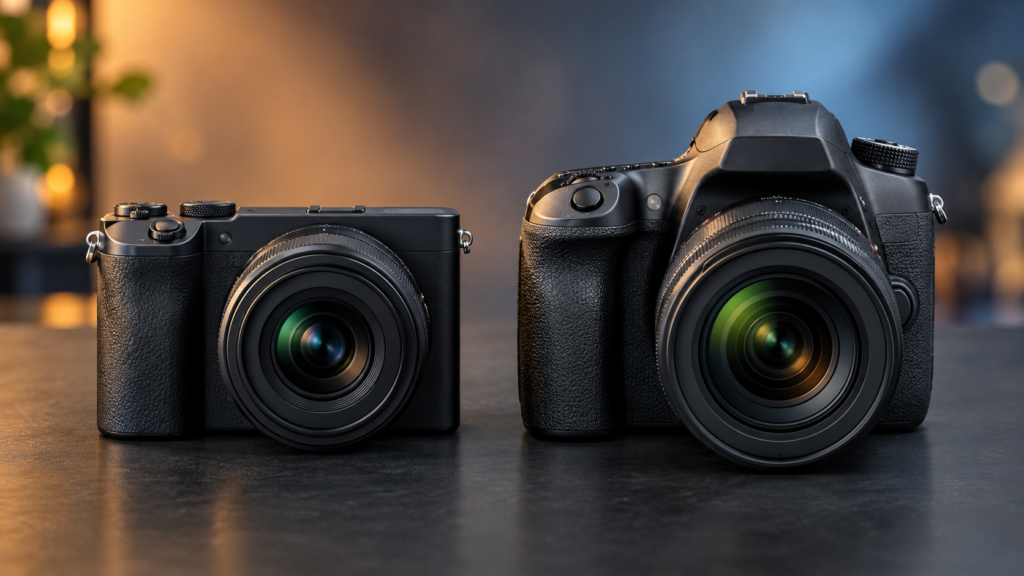
Choosing between a mirrorless camera and a DSLR can be challenging, especially when both types offer excellent image quality, interchangeable lenses, and advanced photography features. Whether you are a beginner exploring photography, a travel enthusiast, a content creator, or a professional photographer, understanding the differences between these camera systems can help you make a better purchasing decision.
Mirrorless cameras have become increasingly popular because of their compact designs, advanced autofocus systems, and impressive video capabilities. Meanwhile, DSLR cameras remain attractive to photographers who appreciate optical viewfinders, long battery life, comfortable handling, and access to an extensive selection of lenses.
However, the best camera is not necessarily the newest or most expensive model. Your ideal choice depends on your photography style, budget, experience, and expectations.
In this article, we compare mirrorless and DSLR cameras across image quality, autofocus, video recording, battery life, lens availability, portability, pricing, and long-term value to help you decide which camera is right for you.
What Is a Mirrorless Camera?
A mirrorless camera is a digital camera that captures images without using the mirror mechanism found in traditional DSLR cameras.
Light passes through the lens directly onto the image sensor. The sensor processes the incoming light and displays a preview on the electronic viewfinder or rear screen.
Because mirrorless cameras do not require a reflex mirror or optical viewfinder system, manufacturers can often create smaller and lighter camera bodies.
Modern mirrorless cameras offer sophisticated features, including real-time subject tracking, eye detection, high-speed continuous shooting, in-body image stabilization, and advanced video recording.
Popular mirrorless camera systems include those offered by Canon, Sony, Nikon, Fujifilm, and Panasonic.
Mirrorless cameras are particularly appealing to travel photographers, vloggers, wildlife enthusiasts, and professionals who want modern autofocus and video features in a relatively compact package.
What Is a DSLR Camera?
DSLR stands for Digital Single-Lens Reflex. These cameras use a mirror mechanism that reflects light entering through the lens into an optical viewfinder.
When you press the shutter button, the mirror moves out of the way, allowing light to reach the image sensor and capture the photograph.
This optical system lets photographers see the scene directly through the lens without relying on an electronic display.
DSLR cameras have been widely used by professionals, hobbyists, sports photographers, and portrait photographers for many years.
Popular DSLR systems include Canon EOS and Nikon DSLR models.
Although manufacturers have increasingly concentrated on mirrorless development, DSLR cameras remain useful photography tools. Their extensive lens selections and established accessories ecosystem can make them attractive to buyers who want capable equipment without investing in an entirely new system.
Mirrorless vs DSLR: Key Differences at a Glance
The following table highlights the main differences between the two camera types.
| Feature | Mirrorless Camera | DSLR Camera |
|---|---|---|
| Camera mechanism | No reflex mirror | Uses a reflex mirror |
| Viewfinder | Electronic or optical-style rear display | Optical viewfinder |
| Size and weight | Generally smaller and lighter | Generally larger and heavier |
| Autofocus | Often advanced subject and eye tracking | Depends on model and shooting mode |
| Image quality | Excellent with comparable sensors and lenses | Excellent with comparable sensors and lenses |
| Video recording | Often offers newer video features | Capabilities vary by model |
| Battery life | Often shorter | Often longer when using the optical viewfinder |
| Continuous shooting | Often very fast, depending on model | Varies by model |
| Lens selection | Extensive and growing | Extensive established used-market selection |
| Silent shooting | Electronic shutter available on many models | Usually limited or unavailable |
| Optical viewfinder | Generally unavailable | Standard feature |
| Beginner suitability | Excellent | Excellent |
| Long-term development | Major focus of camera manufacturers | More limited new-system development |
These differences are general rather than universal. Individual camera models can perform differently, so specifications and real-world reviews matter when comparing specific products.
1. Image Quality: Which Camera Takes Better Photos?
Image quality is one of the most important considerations when buying a camera. However, the difference between mirrorless and DSLR cameras is often smaller than buyers expect.
Both camera types can produce excellent photographs with accurate colors, detailed textures, and impressive dynamic range.
The sensor is a major factor in determining image quality. Cameras with similarly sized sensors and comparable technology can deliver similar results when used with equivalent lenses and appropriate exposure settings.
For example, a full-frame mirrorless camera and a full-frame DSLR can both produce outstanding portraits, landscapes, product photographs, and low-light images.
Sensor size also matters. Full-frame cameras generally offer advantages in low-light performance and depth-of-field control compared with many smaller-sensor cameras, although sensor generation and lens choice also influence the results.
Mirrorless cameras may benefit from newer sensor technology, improved image processing, and advanced autofocus systems. However, these advantages depend on the particular model rather than the absence of a mirror itself.
DSLR cameras can still produce professional-quality images suitable for weddings, commercial photography, wildlife projects, and online publications.
Winner: Tie. Image quality depends more on the sensor, lens, exposure, lighting, and photographer’s skills than on whether a camera is mirrorless or DSLR.
2. Autofocus Performance: Which Camera Focuses Faster?
Autofocus determines how effectively a camera identifies a subject and keeps it sharp.
Mirrorless cameras frequently have an advantage because their autofocus systems operate directly using information from the image sensor. Many modern models combine phase-detection and contrast-detection technologies to achieve fast, accurate focusing.
Advanced mirrorless cameras can recognize and track subjects such as people, animals, birds, vehicles, and aircraft. Eye-detection autofocus can also help photographers maintain sharp focus on a person’s eyes during portraits.
These capabilities are particularly useful when photographing moving children, sporting events, wildlife, or fast-paced activities.
DSLR cameras can also offer excellent autofocus performance. Many models have dedicated phase-detection autofocus systems that work particularly well when using the optical viewfinder.
Professional DSLRs have historically been popular among sports and wildlife photographers because of their reliable subject tracking and responsive controls.
However, focusing performance can differ between viewfinder and live-view shooting. Some older DSLRs offer strong viewfinder autofocus but comparatively limited live-view autofocus capabilities.
For beginners, modern mirrorless autofocus can simplify photography by automatically recognizing and tracking subjects.
Nevertheless, a capable DSLR remains suitable for many photography situations, especially when photographing relatively stationary subjects.
Winner: Mirrorless. Modern mirrorless cameras generally provide more advanced subject recognition and eye-tracking features, although specific DSLR models can still perform exceptionally well.
3. Design, Size, and Portability
Portability matters if you frequently travel, hike, attend events, or carry your camera throughout the day.
Mirrorless cameras are generally smaller because they do not need a reflex mirror mechanism. Their bodies can be particularly compact when paired with appropriately sized lenses.
A lightweight mirrorless camera can make travel photography more comfortable and encourage you to carry your equipment more frequently.
Smaller camera bodies can also be convenient for street photography, everyday photography, and recording videos while traveling.
However, mirrorless cameras are not always significantly lighter as complete systems. Large telephoto lenses, professional zoom lenses, and accessories can increase their overall size and weight.
DSLR cameras are usually bulkier because their internal mirror assembly and optical viewfinder require additional space.
Some photographers actually prefer this larger design. A substantial grip can improve handling, particularly when using heavy lenses or photographing for extended periods.
DSLR bodies also often provide clearly separated physical controls, which experienced photographers may appreciate.
Your choice should therefore consider the weight of the entire camera kit rather than the body alone.
Winner: Mirrorless. Mirrorless cameras generally offer better portability, especially for travel and everyday use.
4. Electronic Viewfinder vs Optical Viewfinder
The viewfinder is another important difference between mirrorless and DSLR cameras.
DSLR cameras use optical viewfinders. These allow you to see the scene directly through the lens using mirrors and optical components.
Many photographers appreciate this natural viewing experience because it does not depend on an electronic display. The view remains clear without the display-related lag or image noise that can affect electronic viewfinders in some situations.
Optical viewfinders also consume little power compared with electronic displays, contributing to DSLR battery efficiency.
Mirrorless cameras commonly use electronic viewfinders, which display a digital preview of the scene.
An electronic viewfinder can show how exposure settings, white balance, and picture profiles affect the final image before you take the photograph.
Depending on the model, it may also display a histogram, focus peaking, subject tracking indicators, and other useful information.
This can make exposure adjustments easier for beginners.
However, electronic viewfinders consume battery power and may introduce display lag or reduced clarity in certain lighting conditions. Modern high-quality models have improved considerably, but performance varies.
Winner: Depends on preference. Choose a DSLR if you strongly prefer an optical viewfinder. Choose mirrorless if you value exposure previews and additional electronic information.
5. Video Recording: Which Camera Is Better?
Video has become essential for YouTube creators, vloggers, social media publishers, educators, and businesses.
Mirrorless cameras generally have an advantage because manufacturers have increasingly prioritized video capabilities in newer models.
Depending on the camera, features may include 4K or higher-resolution recording, high-frame-rate video, advanced autofocus tracking, microphone inputs, headphone monitoring, and professional recording formats.
Many mirrorless models also provide reliable continuous autofocus during video recording.
This is useful when filming yourself, recording interviews, capturing moving subjects, or producing product demonstrations.
Some models include in-body image stabilization, which can help reduce camera shake when recording handheld footage.
However, stabilization performance varies, and it does not eliminate all movement or replace a tripod when maximum stability is required.
DSLR cameras can also record excellent video. Certain models provide high-resolution recording, external microphone connections, and manual controls.
Nevertheless, older DSLR models may lack advanced continuous autofocus during video recording or offer fewer modern recording options.
If video is a major part of your work, compare resolution, frame rates, recording limits, autofocus performance, overheating behavior, and audio connections before buying.
Winner: Mirrorless. Modern mirrorless cameras generally offer a broader range of video-focused features and more convenient autofocus for recording.
6. Battery Life: Which Camera Lasts Longer?
Battery life can become important when photographing weddings, traveling without regular access to charging, or spending an entire day outdoors.
DSLR cameras often provide longer battery life when photographers primarily use the optical viewfinder.
Because an optical viewfinder does not require a continuously powered electronic display, the camera can operate efficiently for extended periods.
Mirrorless cameras typically consume more power because the electronic viewfinder or rear screen must display a live image.
Autofocus tracking, image stabilization, wireless connectivity, and continuous video recording can further increase battery consumption.
However, actual performance depends on the camera model, battery capacity, temperature, shooting style, and settings.
Some mirrorless cameras deliver excellent battery performance, while certain DSLRs may consume more power when using live view or recording video.
You can improve battery life by reducing screen brightness, disabling unnecessary wireless connections, carrying spare batteries, and using power-saving settings.
For travel or professional photography, carrying an additional battery is sensible regardless of the camera system.
Winner: Generally DSLR. DSLR cameras often last longer when using the optical viewfinder, although individual models can differ considerably.
7. Lens Availability and Compatibility
Lenses influence image quality, creative flexibility, and the overall cost of owning a camera.
DSLR systems have an established lens ecosystem. Canon EF and Nikon F lenses, for example, have been available for many years.
This makes the used market particularly attractive for photographers seeking portrait lenses, macro lenses, telephoto lenses, and professional zooms.
Depending on the camera body, older lenses can provide excellent performance at lower prices than comparable new equipment.
Mirrorless systems also offer extensive lens selections, including modern wide-angle, portrait, macro, and telephoto options.
Manufacturers have developed dedicated mirrorless lens mounts that allow designers to create lenses suited to their newer camera systems.
However, lens compatibility requires careful checking. DSLR lenses may work with compatible mirrorless bodies through manufacturer-approved adapters, but autofocus behavior, stabilization, and other functions can vary.
Similarly, not every lens designed for a mirrorless mount will work with every mirrorless camera.
Before purchasing a camera, research the lenses you expect to use and the total cost of building your preferred kit.
Winner: Depends on your needs. DSLR systems can offer excellent used-lens value, while mirrorless systems provide access to newer lenses and continuing product development.
8. Pricing and Overall Value
Budget is often the deciding factor when choosing between a mirrorless camera and a DSLR.
Entry-level mirrorless cameras can cost more than older or used DSLR alternatives, particularly when comparing complete kits.
DSLR cameras may offer excellent value for beginners who want manual controls, interchangeable lenses, and strong image quality without spending heavily.
The used market includes numerous capable DSLR bodies and lenses that remain suitable for learning photography.
However, purchasing a new mirrorless camera may provide access to newer autofocus technology, modern video capabilities, and a system with an active development roadmap.
These benefits can justify a higher initial price for photographers who plan to use their equipment frequently.
Remember that the body is only one part of the total cost.
Your budget should account for lenses, memory cards, spare batteries, camera bags, tripods, and other accessories.
A less expensive body paired with an excellent lens may produce better results than an expensive body paired with an unsuitable lens.
Check local prices, warranty conditions, used-equipment reliability, and accessory compatibility before making a final decision.
Winner: DSLR for budget-conscious buyers; mirrorless for those prioritizing newer features. The best value depends on your budget and intended use.
9. Continuous Shooting and Silent Photography
Continuous shooting allows a camera to capture multiple frames while you hold down the shutter button.
This feature is useful for sports, wildlife, action photography, and situations where timing is critical.
Many mirrorless cameras offer impressive burst speeds, especially when using electronic shutters.
Electronic shutters can also enable silent photography, which is valuable during weddings, performances, conferences, and wildlife observation.
However, electronic shutters have limitations. Rolling-shutter distortion can affect rapidly moving subjects, and artificial lighting may create banding in certain situations.
Some cameras offer stacked sensors or other technologies that reduce these problems.
DSLR cameras can also deliver fast continuous shooting, particularly professional models designed for sports and wildlife photography.
Their mechanical shutter systems can be reliable and responsive, although burst speed varies by camera.
A DSLR’s optical viewfinder also provides a direct view of the scene, while some mirrorless models may experience viewfinder blackout or display interruptions depending on their shooting mode.
Winner: Generally mirrorless. Many newer models offer higher burst speeds and silent electronic shooting, but professional DSLRs remain capable action cameras.
10. Durability and Reliability
Durability matters for photographers who work outdoors, travel frequently, or operate in challenging environments.
Both mirrorless and DSLR cameras are available with weather-sealed bodies designed to resist dust and moisture.
However, weather sealing does not make a camera completely waterproof. Protection levels differ by model, and the lens and other connections can affect overall resistance.
DSLR cameras have a long history of professional use, and many higher-end models feature robust construction designed for demanding conditions.
Mirrorless cameras have also become increasingly durable, with professional models offering strong weather resistance, reinforced bodies, and dependable controls.
Mechanical complexity differs between the systems. DSLRs contain a moving mirror assembly, while mirrorless cameras eliminate that particular mechanism.
Nevertheless, mirrorless cameras still contain mechanical components, including shutters in many models, and both types require appropriate care.
Battery performance in cold weather, grip comfort with gloves, control placement, and service availability may matter more than the camera category itself.
Winner: Tie. Durability depends on the specific model, construction, maintenance, and conditions in which the camera is used.
11. Which Camera Is Better for Beginners?
Beginners should prioritize ease of use, affordability, learning opportunities, and room for future development.
Mirrorless cameras are attractive because their electronic viewfinders and rear displays can show exposure previews before a photograph is taken.
Modern autofocus systems can also reduce the difficulty of photographing moving subjects.
Many mirrorless cameras include guided menus, automatic shooting modes, wireless image transfer, and touchscreen controls.
These features can help beginners learn photography while producing attractive images.
DSLR cameras remain excellent learning tools. Their optical viewfinders encourage photographers to observe a scene directly, and their physical controls can help users understand exposure settings.
Affordable used DSLRs can also provide an economical introduction to interchangeable-lens photography.
Neither system automatically makes someone a better photographer. Understanding composition, lighting, exposure, perspective, and lens selection remains essential.
Winner: Mirrorless for convenience and modern features; DSLR for affordable entry into photography.
12. Which Camera Should Professionals Choose?
Professional photographers should choose equipment based on their working requirements rather than general popularity.
Wedding photographers may prefer mirrorless cameras for eye detection, silent shooting, and video capabilities. However, DSLR cameras can still handle weddings effectively when paired with suitable lenses and lighting equipment.
Wildlife photographers may appreciate the subject recognition, rapid shooting, and lightweight options available in modern mirrorless systems.
Sports photographers may benefit from advanced tracking and high burst rates, although the performance of individual cameras should be evaluated carefully.
Studio photographers often prioritize resolution, color accuracy, tethering support, lens quality, and reliable operation.
For commercial video production, mirrorless cameras may provide more convenient recording features, but dedicated cinema cameras could be more appropriate for advanced workflows.
Professionals already invested in a DSLR system should also consider the cost of changing bodies, lenses, flashes, and accessories.
Winner: Mirrorless for many modern workflows, but the best professional camera depends on the assignment and existing equipment.
Mirrorless vs DSLR: Final Comparison
Here is a quick summary of which camera type is generally better for different needs.
| Photography Requirement | Recommended Camera |
|---|---|
| Travel photography | Mirrorless |
| Everyday photography | Mirrorless |
| Beginner-friendly features | Mirrorless |
| Professional video recording | Mirrorless |
| Advanced subject tracking | Mirrorless |
| Silent photography | Mirrorless |
| Affordable used equipment | DSLR |
| Optical viewfinder preference | DSLR |
| Long battery life through the viewfinder | DSLR |
| Access to an established used-lens market | DSLR |
| Studio photography | Either |
| Portrait photography | Either |
| Landscape photography | Either |
| Wildlife photography | Either, depending on the model |
| Sports photography | Either, depending on autofocus and burst performance |
Frequently Asked Questions (FAQs)
1. Are mirrorless cameras better than DSLR cameras?
Mirrorless cameras generally offer newer autofocus and video features, while DSLRs can provide excellent image quality, battery life, and value.
2. Do mirrorless cameras take better pictures?
Not necessarily. Image quality depends on the sensor, lens, lighting, exposure, and camera settings rather than the mirrorless design alone.
3. Are DSLR cameras becoming obsolete?
DSLR cameras are not obsolete. They remain useful for photography, although manufacturers increasingly focus their research and development on mirrorless systems.
4. Which camera is better for photography beginners?
Mirrorless cameras offer modern autofocus and exposure previews, while affordable DSLRs provide an excellent introduction to interchangeable-lens photography.
5. Are mirrorless cameras more expensive?
Some mirrorless cameras cost more than older DSLRs, but prices vary by model, features, condition, and included accessories.
6. Which camera is better for YouTube videos?
Mirrorless cameras are generally more convenient for YouTube because many models offer advanced video autofocus, high-resolution recording, and useful creator features.
7. Do DSLR cameras have better battery life?
DSLR cameras often provide longer battery life when using their optical viewfinders, although performance varies depending on the model and shooting conditions.
8. Can DSLR lenses be used on mirrorless cameras?
Many DSLR lenses can be adapted to compatible mirrorless cameras, but autofocus performance and other functions depend on the lens, adapter, and camera.
9. Which camera is better for wildlife photography?
Both can work well. Modern mirrorless cameras often offer advanced animal recognition, while DSLRs remain capable when paired with suitable telephoto lenses.
10. Should I buy a DSLR or mirrorless camera in 2026?
Mirrorless is generally the better choice for a new long-term system, while a DSLR can be excellent value if you find suitable equipment at an attractive price.
Conclusion
Choosing between mirrorless and DSLR cameras depends on your priorities, budget, and photography goals.
Mirrorless cameras are generally the stronger choice for buyers seeking modern autofocus, advanced video recording, compact designs, and newer camera technology. Their electronic viewfinders and subject-tracking capabilities can also make photography more convenient.
DSLR cameras remain worthwhile for photographers who prefer optical viewfinders, value longer battery life, or want to take advantage of affordable used camera bodies and lenses.
For beginners purchasing their first interchangeable-lens camera, either system can provide an excellent learning experience. However, if you are investing in a new camera system for the future, mirrorless is usually the more practical starting point.
Before purchasing, compare individual models, test their handling if possible, and consider the total cost of lenses and accessories.
Ultimately, the best camera is the one that fits your needs, feels comfortable to use, and helps you capture the photographs and videos you want.
