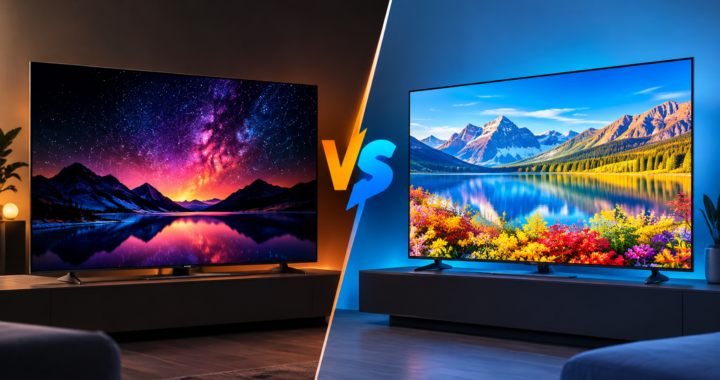
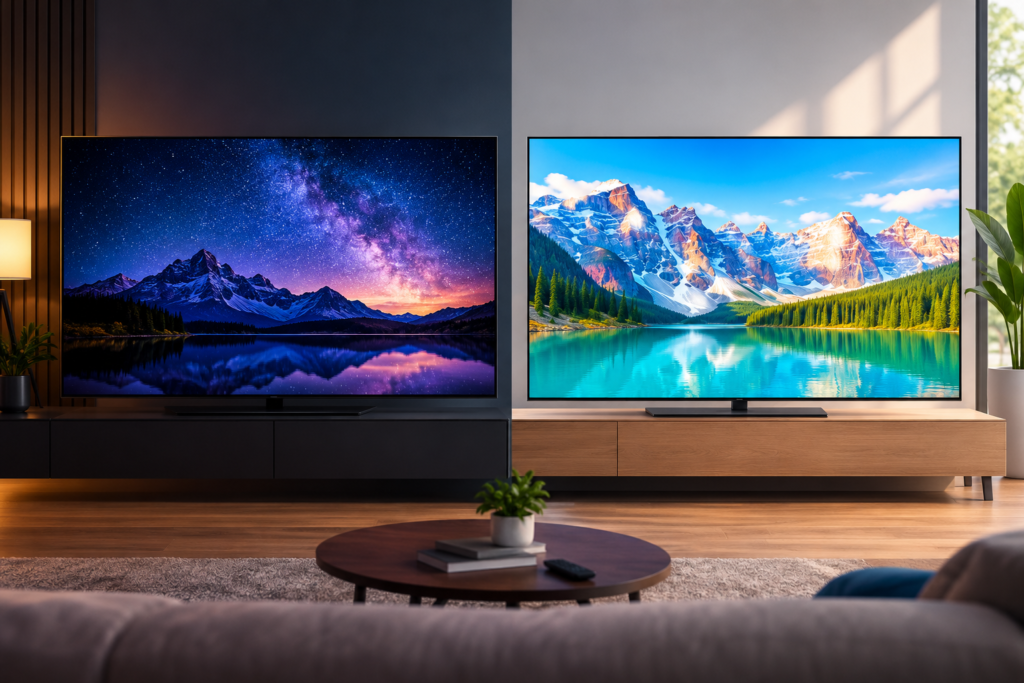
Choosing a new television can be challenging, especially when comparing OLED and QLED display technologies. Both offer impressive picture quality, vibrant colors, and advanced features, but they work differently and are designed to meet different viewing needs. Whether you enjoy watching movies, playing video games, streaming sports, or simply watching television with your family, understanding these technologies can help you make a better purchasing decision.
OLED and QLED televisions are available in various sizes, resolutions, and price ranges. OLED is widely recognized for its deep blacks and excellent contrast, while QLED is known for its brightness and colorful picture quality. However, neither technology is automatically the best choice for every household. Your room’s lighting, viewing habits, budget, and preferred content all influence which display will provide the best experience.
In this article, we compare OLED and QLED televisions across picture quality, brightness, contrast, color reproduction, gaming performance, durability, energy consumption, and price. By examining their strengths and limitations, you can determine which technology is better suited to your needs.
What Is OLED Technology?
OLED stands for Organic Light-Emitting Diode. Unlike conventional LED televisions, OLED displays do not require a separate backlight to illuminate their pixels. Instead, each pixel produces its own light.
This pixel-level illumination gives OLED televisions a significant advantage when displaying dark scenes. Individual pixels can switch off completely, producing true black rather than attempting to reduce the brightness of a backlight.
For example, when watching a movie featuring a star-filled night sky, an OLED television can display bright stars against a completely black background. Because the pixels surrounding those stars can turn off independently, the image appears highly detailed and realistic.
OLED technology also provides excellent viewing angles, making it suitable for households where several people watch television from different positions.
Another important advantage is its fast pixel response time. Pixels can change between colors extremely quickly, helping reduce motion blur during fast-moving scenes and video games.
However, OLED televisions have some limitations. They can be more expensive than many comparable QLED models, and their brightness may be lower than that of high-performance QLED televisions. OLED displays also carry a risk of permanent image retention, commonly called burn-in, when static images remain on the screen for extended periods under certain conditions.
Despite these considerations, OLED remains a popular option for viewers who prioritize cinematic picture quality.
What Is QLED Technology?
QLED stands for Quantum Dot Light-Emitting Diode. Despite the similar names, conventional QLED televisions use a different display structure from OLED models.
Most QLED televisions are based on LCD technology and use an LED backlight to illuminate the screen. A quantum dot layer helps produce more precise and vibrant colors when illuminated by the backlight.
This design allows QLED televisions to deliver high brightness and a wide color range. Many models are particularly effective in rooms with substantial natural light, where a dimmer display may struggle to remain clearly visible.
Some QLED televisions also use local dimming, which divides the backlight into separate zones. These zones can become brighter or darker depending on the content being displayed. More advanced models may use Mini-LED backlighting, which allows for more precise control over these zones.
However, because conventional QLED televisions rely on a backlight, they generally cannot turn off individual pixels in the same way OLED televisions can. This can cause light to spread into dark areas around bright objects, a phenomenon known as blooming.
QLED televisions are available across a broad range of prices, including affordable options and premium models with sophisticated backlighting systems.
Important distinction: QLED is not the same as OLED, and it should not automatically be confused with QD-OLED. QD-OLED combines OLED light-emitting technology with quantum dots to produce color, offering characteristics that differ from conventional QLED and traditional OLED displays.
OLED vs QLED: Key Differences at a Glance
Understanding the main differences between OLED and QLED televisions makes it easier to compare their performance.
| Feature | OLED TV | QLED TV |
|---|---|---|
| Display technology | Self-emissive pixels | LCD panel with quantum dots and backlight |
| Black levels | Excellent, with true black | Depends on backlight and dimming system |
| Contrast | Excellent pixel-level contrast | Varies by model |
| Brightness | Strong, but varies by model and scene | Often excellent, especially in bright rooms |
| Color reproduction | Excellent and highly accurate on suitable models | Vivid colors and a wide color range |
| Viewing angles | Generally very wide | Vary by panel technology |
| Motion handling | Excellent pixel response | Depends on panel response and processing |
| Burn-in risk | Possible under certain usage patterns | No comparable OLED-style pixel burn-in |
| Gaming | Excellent response and contrast | Excellent on suitable high-refresh-rate models |
| Bright rooms | Good, depending on model | Often particularly suitable |
| Dark-room movies | Excellent | Good to excellent on advanced models |
| Price | Often higher for comparable premium models | Wide range, including budget-friendly options |
Actual performance varies considerably between television models, so buyers should compare individual specifications rather than relying on display labels alone.
1. Picture Quality: Which Looks Better?
Picture quality is one of the most important factors when purchasing a television. OLED and QLED can both deliver excellent images, but their strengths become noticeable in different situations.
OLED televisions are particularly impressive when displaying dark scenes. Because each pixel generates its own light, the television can maintain black areas without illuminating neighboring pixels.
This capability creates exceptional contrast and helps preserve details in dark movies, nighttime scenes, and atmospheric video games.
QLED televisions can also produce attractive, detailed images, especially when equipped with high-quality panels and advanced local dimming. Premium QLED models can deliver excellent contrast, although their performance depends heavily on the number and precision of their dimming zones.
In some scenes, light from a bright object can affect nearby dark areas on a QLED television. This effect is generally less noticeable on models with sophisticated Mini-LED backlighting.
Winner for dark-room picture quality: OLED.
For viewers who frequently watch movies in a dark or dimly lit room, OLED generally offers the more consistent experience because of its pixel-level light control.
2. Brightness: Which Is Better for Bright Rooms?
Brightness can significantly affect how enjoyable a television is during daytime viewing.
Large windows, sunlight, overhead lighting, and reflections can make it difficult to see darker television screens clearly. In these conditions, a television with strong brightness performance can provide a more comfortable viewing experience.
QLED televisions often have an advantage in this category. Many models, particularly premium Mini-LED versions, can achieve very high peak brightness and maintain a bright picture across substantial portions of the screen.
This makes them attractive for living rooms with large windows, open spaces, and substantial ambient lighting.
OLED televisions have improved considerably in brightness, and some premium models perform extremely well in bright environments. Nevertheless, their brightness behavior differs by model and content. Some OLED displays reduce brightness when large portions of the screen remain intensely illuminated.
Room reflections also matter. A bright television can still be difficult to watch if its screen produces distracting reflections.
Winner for bright-room viewing: QLED in many cases.
If your television will be placed in a sunny living room, compare brightness measurements, screen reflectivity, and performance with real-world content before choosing a model.
3. Black Levels and Contrast
Black levels describe how effectively a television displays dark portions of an image. Contrast refers to the difference between the brightest and darkest parts of the picture.
OLED televisions have a major advantage because individual pixels can turn off completely. When displaying black, an OLED pixel does not need to emit light.
This creates exceptionally deep blacks and helps make small highlights appear more prominent. The result is especially noticeable when watching science-fiction movies, dark dramas, and nighttime sports footage.
QLED televisions use a backlight, so their ability to display black depends on how effectively that light can be controlled. Basic models may produce dark gray rather than true black in challenging scenes.
High-end QLED televisions with full-array local dimming or Mini-LED technology can significantly improve contrast. However, bright objects on dark backgrounds may still reveal some blooming.
Winner: OLED.
For people who prioritize deep blacks, strong contrast, and cinematic viewing, OLED is generally the better choice.
4. Color Accuracy and Color Volume
Color quality affects how natural and realistic a television looks.
Both OLED and QLED televisions can reproduce a wide range of colors, including the vivid shades used in HDR movies, streaming programs, and modern video games.
OLED displays are capable of excellent color accuracy and can produce nuanced shades, particularly when properly calibrated. Their strong contrast also helps colors appear rich against dark backgrounds.
QLED televisions use quantum dots to improve color reproduction. These materials can help produce saturated colors at high brightness levels, making colorful images stand out in brightly lit environments.
However, vivid colors do not necessarily mean accurate colors. A television with an overly saturated picture setting may make skin tones, landscapes, and clothing appear less natural.
Color performance also depends on the panel, processing system, calibration, and supported HDR formats.
Winner: It depends on the model and viewing conditions.
OLED is an excellent option for cinematic color presentation, while QLED can be especially impressive when displaying bright, colorful HDR content. Compare calibrated performance whenever possible.
5. Viewing Angles: Which Is Better for Families?
Viewing angles determine how well a television maintains its picture quality when watched from the side.
This matters when family members sit across a wide sofa, several people watch a movie together, or the television is positioned in a large room.
OLED televisions generally offer excellent viewing angles. Colors and contrast remain relatively consistent when viewers move away from the center of the screen.
QLED viewing angles vary according to the LCD panel technology. Some models maintain good picture quality from the side, while others show reduced contrast or color changes at wider angles.
Certain premium QLED televisions incorporate technologies designed to improve off-axis viewing, but performance is not uniform across the category.
Winner: OLED in most comparisons.
If multiple people frequently watch television from different seating positions, OLED is usually a dependable choice. However, check the viewing-angle performance of the specific QLED model you are considering.
6. Gaming Performance: OLED vs QLED
Modern televisions offer features designed to improve gaming, including high refresh rates, variable refresh rate support, automatic low-latency modes, and HDMI 2.1 connectivity.
OLED televisions are particularly attractive to gamers because of their extremely fast pixel response times. Rapid transitions between dark and bright scenes can appear clear, and fast-moving objects may show less motion blur.
Many OLED models also support refresh rates of 120Hz or higher, depending on the product. This can make compatible games feel smoother and more responsive.
QLED televisions can also provide excellent gaming performance. Many models support high refresh rates, variable refresh rate technology, and low-latency gaming modes.
Premium QLED and Mini-LED televisions can be especially appealing for gamers who play in bright rooms or want a large, bright display.
However, specifications differ significantly between entry-level and premium models. Some inexpensive televisions lack features found in gaming-focused products.
OLED burn-in is also worth considering if you regularly play games that display static interface elements for many hours. Modern OLED televisions include protective features, but these reduce rather than completely eliminate the risk.
Winner: OLED for response time and contrast; QLED can be excellent for bright-room gaming.
For competitive gaming, compare input lag, refresh rate, supported VRR formats, HDMI ports, and the television’s actual performance rather than choosing based on panel technology alone.
7. Movies and Streaming: Which Offers the Best Experience?
Movie enthusiasts often value realistic colors, deep blacks, subtle shadow details, and support for high-quality HDR content.
OLED televisions excel at creating a cinematic experience in dark rooms. Their pixel-level lighting allows bright highlights to appear against completely black backgrounds without the same backlight blooming that can occur on LCD-based televisions.
This can be especially beneficial when watching films with dark cinematography or streaming high-quality HDR content.
QLED televisions offer a different set of strengths. Their high brightness can help HDR highlights stand out, and many models deliver vibrant colors that make nature documentaries, animated films, and action movies look impressive.
A premium QLED television with effective local dimming can provide an outstanding movie experience, particularly when the room is brightly lit.
Streaming quality also depends on the source. Low-resolution or heavily compressed content may look less detailed regardless of the television technology.
For the best results, consider resolution, HDR support, image processing, and the availability of high-quality streaming content.
Winner for dark-room cinema: OLED.
Winner for bright-room entertainment: Often QLED.
8. Burn-In and Long-Term Durability
Durability is an important consideration because televisions are typically expected to last for several years.
OLED displays use organic light-emitting materials. Over time, these materials can age, and uneven wear may produce persistent differences in brightness or color. This is commonly associated with burn-in.
Burn-in is more likely when the same static elements remain visible for extended periods, especially under demanding usage conditions. Examples include persistent news tickers, fixed channel logos, or frequently displayed game interfaces.
Modern OLED televisions use protective measures such as pixel shifting, screen maintenance routines, and brightness management to reduce this risk. Normal mixed-content viewing does not automatically lead to burn-in, but the possibility remains.
QLED televisions do not have the same OLED-style pixel burn-in mechanism because they use an LCD panel and a separate backlight.
However, QLED televisions are not immune to every type of display problem. Backlights, electronic components, and LCD panels can still experience faults or deterioration.
Winner for avoiding OLED-style burn-in: QLED.
If you frequently display static information, operate a television as a computer monitor for long periods, or use it continuously for digital signage, QLED may offer greater peace of mind.
9. Energy Consumption
Electricity consumption depends on screen size, brightness settings, picture mode, content, and the television’s overall design.
OLED power consumption changes according to the image being displayed. Dark scenes may use less energy because many pixels emit little or no light. Bright scenes containing large white areas can require substantially more power.
QLED televisions use a backlight, which consumes energy whenever the display is illuminated. Power requirements vary with backlight intensity, local dimming behavior, screen size, and panel efficiency.
A bright QLED television operating at maximum brightness may consume more electricity than a dimmer television, but this does not mean every OLED is more efficient than every QLED.
For a meaningful comparison, check the energy label and standardized consumption figures for the exact models you are considering.
Reducing unnecessary brightness and enabling automatic power-saving features can also help reduce electricity usage.
Winner: No universal winner.
Choose an energy-efficient model based on verified consumption figures rather than assuming one technology always uses less electricity.
10. Price and Value for Money
Price is often the deciding factor when comparing OLED and QLED televisions.
QLED technology is available in a wide range of products, from relatively affordable televisions to expensive premium models. This makes it easier to find a QLED television that fits a specific budget.
OLED televisions are often positioned in the premium segment, although prices vary by screen size, brand, model generation, and promotional offers.
A midrange QLED television may provide excellent brightness, a large screen, and useful smart features for less money than a comparable OLED model.
On the other hand, buyers who prioritize deep blacks and premium cinematic picture quality may find the additional cost of OLED worthwhile.
It is important to compare televisions with similar screen sizes, resolutions, refresh rates, and feature sets. Comparing an entry-level QLED television with a flagship OLED model may produce misleading conclusions.
Also consider warranty coverage, after-sales service, replacement costs, and the availability of software updates.
Winner for budget flexibility: QLED.
Winner for premium dark-room picture quality: OLED.
The best value depends on what you watch most often and which features matter most to you.
11. OLED vs QLED for Different Types of Users
The right display technology depends on your everyday viewing habits.
For movie enthusiasts: OLED is generally the better choice for watching films in a dark room because of its excellent black levels and contrast.
For sports fans: QLED may be preferable in bright living rooms because of its strong brightness. OLED is also excellent for sports, particularly when wide viewing angles and fast response times matter.
For gamers: OLED is appealing for its fast pixel response and excellent contrast. High-performance QLED models are also strong choices, particularly for bright rooms and users concerned about persistent static interfaces.
For families: OLED generally offers better viewing angles, while QLED may be a practical option for bright shared spaces.
For budget-conscious buyers: QLED offers many affordable choices, although prices and performance vary widely.
For people who watch news channels all day: QLED may be a sensible option if persistent channel logos and static graphics remain visible for extended periods.
For large, sunny living rooms: A bright QLED or Mini-LED television is often worth considering.
For home cinema rooms: OLED is an excellent choice when the room can be kept relatively dark.
12. Important Features to Check Before Buying
Although OLED and QLED labels are useful starting points, several other specifications influence the overall experience.
Resolution: A 4K television is a practical choice for most modern households. Some premium televisions offer 8K resolution, but suitable native content remains limited.
Refresh rate: A genuine 120Hz panel can provide smoother motion than a 60Hz panel, particularly for compatible games and sports.
HDR support: Look for the HDR formats supported by the television and the streaming services you use. HDR performance depends on more than format compatibility alone.
Local dimming: For QLED televisions, the quality of local dimming can significantly influence black levels and contrast.
HDMI connectivity: Check the number and capabilities of HDMI ports, especially if you use gaming consoles, soundbars, and streaming devices.
Screen reflections: A screen with effective reflection handling may be more useful than a slightly brighter model in a room with windows.
Operating system: Consider the available streaming applications, interface responsiveness, software support, and ease of use.
Warranty and service: Review the warranty terms and local service arrangements, particularly for premium televisions.
Screen size: Select a size that suits your viewing distance, room layout, and budget.
These factors can sometimes make a larger difference to satisfaction than the difference between two display technologies.
13. Is OLED Better Than QLED Overall?
OLED and QLED televisions are designed around different priorities, which explains why neither technology wins in every category.
OLED is particularly strong in black levels, contrast, viewing angles, and pixel response time. These advantages make it an excellent choice for cinematic viewing, dark-room entertainment, and many gaming setups.
QLED is particularly attractive for its brightness, broad range of prices, and lack of the same OLED-style burn-in risk. Premium QLED and Mini-LED televisions can also produce excellent contrast and impressive HDR highlights.
The decision becomes easier when you focus on your room and viewing habits instead of relying on marketing claims.
If you usually watch movies at night, prioritize picture quality, and have a flexible budget, OLED is likely to suit you better.
If you watch television during the day, have a bright living room, want a large screen for a limited budget, or frequently display static content, QLED may be the more practical choice.
Before purchasing, compare independent reviews and measurements of the exact models available in your market. A well-designed QLED television can outperform a basic OLED in certain situations, just as an excellent OLED can provide a better overall image than many conventional QLED models.
Frequently Asked Questions
1. Which is better, OLED or QLED?
OLED generally offers better black levels and contrast, while QLED often provides higher brightness and more budget-friendly choices.
2. Is OLED worth the extra money?
OLED can be worth the additional cost if you prioritize cinematic picture quality, deep blacks, wide viewing angles, and fast pixel response.
3. Do QLED televisions have better brightness?
Many QLED televisions achieve higher peak brightness than comparable OLED models, although performance varies by model and generation.
4. Can OLED televisions suffer from burn-in?
Yes. OLED burn-in is possible after prolonged exposure to static images, although modern protective features help reduce the risk.
5. Are QLED televisions better for gaming?
QLED televisions can be excellent for gaming, especially in bright rooms. OLED often has an advantage in pixel response time and contrast.
6. Which technology is better for watching movies?
OLED is generally better for dark-room movie viewing because it produces true black and excellent contrast.
7. Do OLED televisions consume less electricity?
Not always. Power consumption depends on brightness, displayed content, screen size, and the efficiency of the specific television.
8. Is QLED the same as OLED?
No. Conventional QLED televisions use an LCD panel with a backlight and quantum dots, while OLED displays use self-emissive pixels.
9. Which television lasts longer?
Longevity depends on product quality, usage, and operating conditions. QLED avoids OLED-style pixel burn-in, but neither technology guarantees a longer lifespan.
10. Is Mini-LED better than OLED?
Mini-LED can deliver excellent brightness and improved LCD contrast, while OLED generally maintains an advantage in pixel-level black control.
Conclusion
Choosing between OLED and QLED televisions ultimately comes down to your priorities, viewing environment, and budget. Both technologies can deliver outstanding entertainment experiences, but their differences make each more suitable for particular situations.
OLED is the preferred choice for many movie enthusiasts and gamers who value deep blacks, excellent contrast, wide viewing angles, and rapid pixel response. Its ability to illuminate each pixel independently creates a highly immersive picture, particularly in dark rooms.
QLED is an excellent alternative for households that need strong brightness, vibrant colors, flexible pricing, and a display that does not carry the same OLED-style burn-in risk. Premium QLED and Mini-LED televisions can also deliver impressive HDR performance and contrast.
Before making a final decision, compare the specific models available, consider your room’s lighting, and review their brightness, refresh rates, connectivity, energy consumption, and warranty coverage.
Final verdict: Choose OLED for exceptional dark-room picture quality and cinematic contrast. Choose QLED for bright-room viewing, flexible budgets, and reduced concern about OLED-style burn-in. The better television is the one that best matches your everyday needs.